
Lots of people have been sending me this paper by Erik Andrulis, and most of you have done so with eyebrows raised, pointing out that it’s bizarre and unbelievable; some of you wrote asking whether it was believable, at which point my eyebrows went up. Come on people: when you see one grand cosmic explanation that is summarized with cartoons, which the author claims explains everything from the behavior of subatomic particles to the formation of the moon, shouldn’t you immediately sense crankery?
It’s also getting cited all over the place, from World of Warcraft fan sites to the Discovery Institute (those two have roughly equal credibility in matters of science), so I had to skim through it. I read it with rising concern: Erik Andrulis is a young assistant professor at Case Western Reserve University, and he’s published entirely sensible papers on RNA processing. This paper is so weird and out there that it is either an attempt to Sokal the field of origins of life research, or the man is seriously mentally ill. Either way, this is not going to help his career in the slightest.
The paper is titled Theory of the Origin, Evolution, and Nature of Life, and just the sweeping grandiosity of that title should set off alarm bells. Here is the abstract:
Life is an inordinately complex unsolved puzzle. Despite significant theoretical progress, experimental anomalies, paradoxes, and enigmas have revealed paradigmatic limitations. Thus, the advancement of scientific understanding requires new models that resolve fundamental problems. Here, I present a theoretical framework that economically fits evidence accumulated from examinations of life. This theory is based upon a straightforward and non-mathematical core model and proposes unique yet empirically consistent explanations for major phenomena including, but not limited to, quantum gravity, phase transitions of water, why living systems are predominantly CHNOPS (carbon, hydrogen, nitrogen, oxygen, phosphorus, and sulfur), homochirality of sugars and amino acids, homeoviscous adaptation, triplet code, and DNA mutations. The theoretical framework unifies the macrocosmic and microcosmic realms, validates predicted laws of nature, and solves the puzzle of the origin and evolution of cellular life in the universe.
Having skimmed through all 105 pages of this thing, I can tell you with confidence that it answers none of those questions. Just the fact that it is entirely non-mathematical and non-empirical (there aren’t any observations or experiments described at all), and that the entirety of the theory is built around diagrams sketched out by the author, should also tell you that this is not a useful or predictive theory.
It does not have an auspicious beginning. In addition to being constructed around cartoons and being a non-mathematical Theory of Everything, it has to introduce an elaborate collection of neologisms that make the whole paper painful to read.
In the theory proposed herein, I use the heterodox yet simple gyre—a spiral, vortex, whorl, or similar circular pattern—as a core model for understanding life. Because many elements of the gyre model (gyromodel) are alien, I introduce neologisms and important terms in bold italics to identify them; a theoretical lexicon is presented in Table 1. The central idea of this theory is that all physical reality, stretching from the so-called inanimate into the animate realm and from micro- to meso- to macrocosmic scales, can be interpreted and modeled as manifestations of a single geometric entity, the gyre. This entity is attractive because it has life-like characteristics, undergoes morphogenesis, and is responsive to environmental conditions. The gyromodel depicts the spatiotemporal behavior and properties of elementary particles, celestial bodies, atoms, chemicals, molecules, and systems as quantized packets of information, energy, and/or matter that oscillate between excited and ground states around a singularity. The singularity, in turn, modulates these states by alternating attractive and repulsive forces. The singularity itself is modeled as a gyre, thus evincing a thermodynamic, fractal, and nested organization of the gyromodel. In fitting the scientific evidence from quantum gravity to cell division, this theory arrives at an understanding of life that questions traditional beliefs and definitions.
Here’s a partial copy of his lexicon. It goes on quite a bit longer than what I’ve copied here.
Table 1. Gyromodel Lexicon
Alternagyre A gyrosystem whose gyrapex is not triquantal Dextragyre A right-handed gyre or gyromodel Focagyre A gyre that is the focal point of analysis or discussion Gyradaptor The gyre singularity—a quantum—that exerts all forces on the gyrosystem Gyrapex The relativistically high potential, excited, unstable, learning state of a particle Gyraxiom A fact, condition, principle, or rule that constrains and defines the theoretical framework Gyre The spacetime shape or path of a particle or group of particles; a quantum Gyrequation Shorthand notation for analysis, discussion, and understanding gyromodels Gyrobase The relativistically low potential, ground, stable, memory state of a particle Gyrognosis The thermodynamically demanding process of learning and integrating IEM Gyrolink The mIEM particle that links two gyromodules in a gyronexus Gyromnemesis The thermodynamically conserving process of remembering and recovering IEM Gyromodel The core model undergirding the theoretical framework Gyromodule A dIEM particle in a gyronexus Gyronexus A polymer of dIEM particles linked by mIEM particles Gyrostate The potential and/or kinetic state that a particle occupies in its gyratory path Gyrosystem A gyromodel with specific IEM composition, organization, and purpose IEM Information, energy, and/or matter
I can’t help myself. You knew this was coming.
Twas brillig, and the slithy toves
Did gyre and gimble in the wabe:
All mimsy were the borogoves,
And the mome raths outgrabe.
Now I know that you are in lexical shock right now, but I’m about to make it worse. Witness the use of these terms in figure 1 of the paper, which will also reveal the kinds of diagrams he’s using.
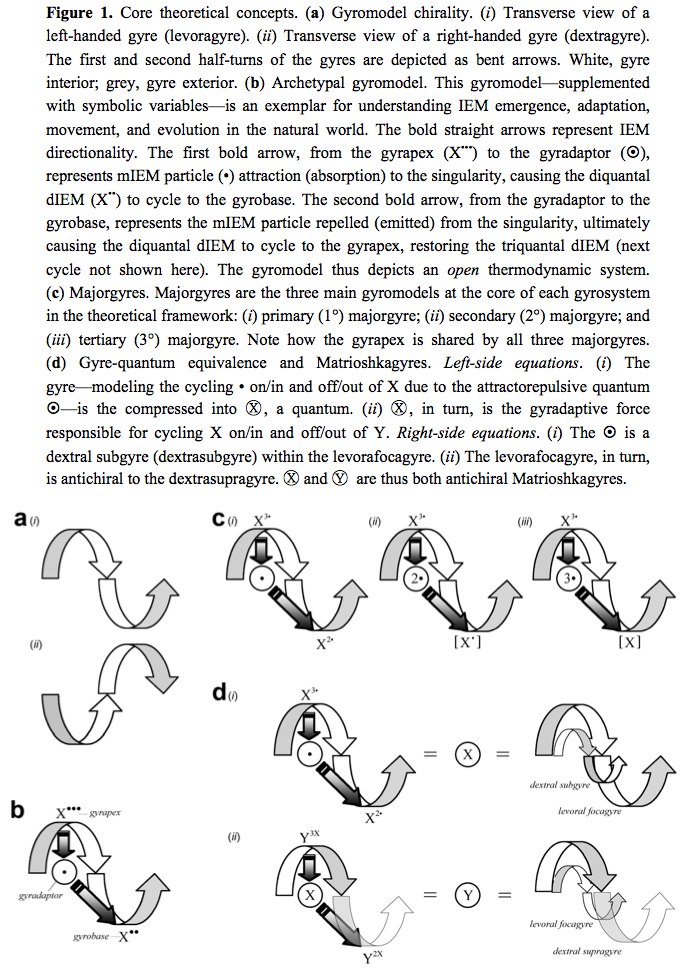
“The levorafocagyre, in turn, is antichiral to the dextrasupragyre” is a nice sentence that about sums up the experience of reading this thing. Don’t believe me? Here are more excerpts that illustrate the grand, cosmic, and entirely uninformative nature of gyroexplanatory gyrobabble. Andrulis purports to explain everything from learning and memory (learning and memory by gyres, not the poor people trying to understand his paper):
The ultimate state of gyromnemesis is the stably adapted particle or gyronexus in the gyrobase. A particle thus adapts through learning and memory by completing one full cycle—a revolution— around the singularity. Taken together, gyrognosis defines IEM integration and assessment whereas gyromnemesis defines IEM storage and recovery. Finally, although a diquantal IEM (X”) undergoes gyrognosis as the gyrobase of a primary majorgyre, it undergoes gyromnemesis as the gyrapex of an alternagyre. Thus, gyre learning and memory are relative to the gyradaptive singularity.
To the formation of Earth’s moon:
Lunar Formation. The favored hypothesis for the formation of Earth’s Moon is from planetesimal impact on a proto-Earth proceeded by matter ejection, accretion, and gravitational capture [189,190]. However, the question of lunar origin has not been settled since there are competing, albeit antiquated hypotheses [191,192]. I also discovered the stunning admission that, “…shamefacedly, [astronomers] have little idea as to where [the Moon] came from. This is particularly embarrassing… [193].” The oxygyre models the Moon as a macroxyon that has a macroelectron within itself; this simple gyrosystem accounts for the known chemical composition of the Moon surface, oxides [194]. Regarding lunar origin, the macroxyon that is the Moon emerges from the macroelectron that is the Earth, concomitant with the emergence of Earth’s macroxyon [195,196].
Several additional points can be derived from this gyrosystem. First, the oxygyre explains water on and in the Moon [197-199]. Second, the gyrating effects of the macroxygyre model the rotation of the Moon on its axis. Third, the path of a less exergic macroxyon (Moon) around more exergic one (Earth) follows an ohiogyre path, or lunar orbit. Fourth, this oxygyre provides insight into how tidal cycling is linked to lunar orbit and axial rotation [200] since the Earth’s oceans (macroxymatrix) and Moon itself (a macroxyon) exert complementary attractorepulsive forces. Fifth, this theoretical union also helps clarify short-term chronobiological ([201]; see 3.8) and long-term geophysical [202] relationships. Sixth, the craters that cover planetary, lunar, and satellite surfaces [203-205]—most if not all of which are near-perfect circles—bear the signature of the macroelectron singularity and its strong thermodynamic force on the oxygyre [206].
You know what? That doesn’t explain anything!
While the strange terminology and nonsensical claims could be clues that this is an elaborate Poe of some sort, the story I’ve heard from some other sources is that Andrulis is not getting tenure and will be leaving Case next year, and that he seems to have a history of tuning in and out — so what this most likely is is a developing personal tragedy. I hope he gets the care he clearly needs; his other work suggests that this is an intelligent mind that is currently going off the rails.
Setting Andrulis aside, though, there are other problems here. How did this paper get published? It’s terrible: unreadable, incoherent, bizarre, and completely lacking in evidence or mathematical support. This is from the very first issue of a new journal, Life, which also contains a perfectly reasonable general summary of origins of life research by Stuart Kauffman alongside Andrulis’s ghastly dreck. There seems to be a complete lack of editorial discrimination at the journal; this is not the way to build a reputation. Or rather, it is, but not a desirable one.
And then there is Science Daily, which seems to be the source where most of my correspondents found this paper. Science Daily is an incredibly annoying source: all they do is republish, without any kind of intelligent assessment, press releases. They suck. What good is mindless regurgitation?
And finally, there’s Case Western Reserve University, which must bear a share of the blame. Where did the press release come from? Why, from the Media Relations office at CWRU. Somebody wrote the press release that begins like this:
The earth is alive, asserts a revolutionary scientific theory of life emerging from Case Western Reserve University School of Medicine. The trans-disciplinary theory demonstrates that purportedly inanimate, non-living objects—for example, planets, water, proteins, and DNA—are animate, that is, alive. With its broad explanatory power, applicable to all areas of science and medicine, this novel paradigm aims to catalyze a veritable renaissance.
It’s madness stamped with the Case Western Reserve University School of Medicine seal of approval. If Andrulis did Sokal the journal, he also Sokal’ed the institution that employs him. Who wrote that bullshit? Do they have anyone competent review their press releases before they mail them out to the whole wide world? Was there anyone thinking in all the steps from crank professor to PR department to journal editor to reviewers? There were so many points where this crackpottery should have been detected and rejected, and it didn’t happen.
(Also on Sb)
Science Daily has informed me that they have removed the press release from their site, and that it should never have made it through in the first place.
Also, apparently Case Western has removed the press release from their listings.

I pointed out@468, nettlecrank, that natural selection is not a theory, but a concept, and hence the question of disproving it does not even arise. OTOH, the theory of evolution by natural selection is not only falsifiable, but in its strongest form – that natural selection is responsible for all evolutionary change – it has been falsified, by the discovery that neutral mutation and drift are universal phenomena among organisms, and by the discovery of speciation by polyploidy in plants. In a slightly weaker form – that natural selection is responsible for most adaptive evolutionary change and most speciation – it is again certainly falsifiable, since there are alternative mechanisms that would produce different patterns of change through time. For example, with regard to adaptive change, it could be, logically, that acquired adaptations were inherited – so a human being, or a horse, that lifted or pulled heavy weights and so grew larger and stronger muscles, would give rise to offspring with larger and stronger muscles than if they had not done so. If this were so, it would be possible to produce rapid, and long-continued heritable change in a desired direction in a population of organisms (such as adaptation to drought in crops) by manipulating its environment – in this case, by reducing available water. The theory that this is possible was tested to destruction – unfortunately, human destruction – by the Lysenkoists in Stalin’s Soviet Union. Had they succeeded, the theory that natural selection produces most adaptive evolutionary change would have been well on the way to being falsified, since this would have been a far more powerful mechanism. Again, with regard to speciation, it could be that most or all speciation results from sudden chromosomal rearrangements, with natural selection playing no part. As I noted, this is indeed sometimes the case, as in polyploidy in plants. The theory of punctuated equilibrium proposes that speciation generally depends on genetic drift in a small, isolated population, rather than on natural selection. I’m not intimately familiar with the literature on this, but I believe the current consensus is that this is not usually so, and natural selection does indeed have an important role in the great majority of cases. However, the point is that this is an empirical question, and once again, the theory of evolution by natural selection is quite clearly falsifiable.
I can’t play the nettlecrank drinking game any more. I’mm getttinngg tooo dddrrunnk toooo connnnnnnnnntinueeeeeeeeeeeeeee…………
nettleingenting:
Quick question:
Are Newton’s Laws falsifiable?
nettleingenting: *headfloor*
Read the gazillion times we’ve explained falsifiability to you again, then come back.
Again: falsifiable does not equal false.
You claim to have several scientific degrees? How come the concept of falsifiability is so alien to you? I studied this in like my 1st or 2nd bachelor year. This is basic scientific philosophy, damnit.
To use your own example: the claim that your nick is nettleingenting IS falsifiable, since we can look at the name you are using, and if it happened to be something else (let’s say proctogyre) the claim would be falsified. The claim happens to be an accurate claim, so it isn’t falsified, but that doesn’t make it any less falsifiable. See how that works?
Oh… Why do I even ask.
Stone me, but your stupidity is truly egregious. Look, fuckwit, first of all, falsifiability is a property of general hypotheses or theories, not of singular statements of observable fact such as that your nym is nettleingenting. With regard to such general hypotheses or theories, falsifiability means that the hypothesis is epistemologically capable of being proved false – that is, there is some set of observations that, if they were made, would show it to be false, because they conflict with valid logical inferences from the hypothesis or theory. A hypothesis can be falsifiable – we can specify some set of observations that would show it to be false, but also correct – in which case, provided observations are without error, it will never actually be falsified. Jesus wept, what will it take to get this elementary point through that lump of concrete you appear to use for a head?
I’ve given up on that ever happening, really.
This one is worse than David Buckna. I wonder if he is a Hovindbot.
I should have said, @506, that the concept of falsifiability is usually only applied to general hypotheses – but as pentatomid points out @505, it can be applied to singular statements of fact.
If the entire universe consisted of one gigantic head and one giant desk, that still wouldn’t be a big enough supercollider to generate the proper response.
I’m currently pretending it’s “needlenose.” I’m not sure what the hell that has to do with anything, though.
It’s what happens when you attempt and fail to falsify. You see data that supports the theory.
Christ, this is worse than pointing something out to a dog only to have him stare at your finger. I mean, at least the dog won’t spend the next three weeks asking about that finger.
I’ve had more useful conversations with myself in the bathtub on acid.
I really like the way that you wrote this.
Interesting thing that. Apparantly, most dogs do actually understand the act of pointing, yet many primates, including apes, don’t get that simple gesture.
Uhm… Yeah… Random…
Kids, this is your brains on crank.
Oh, do you?
My Master’s thesis was about the body size evolution of dinosaurs – about the question whether “Cope’s rule” holds for them, the question whether they got bigger and bigger over time. My doctoral thesis was about the origin(s) of the modern amphibians – about the question which 300-million-year-old animals are most closely related to today’s amphibians.
Yours?
No, you just haven’t paid attention.
Punk eek is only distinguishable from completely gradual evolution at a very fine scale, just tens of thousands of years. That kind of fine resolution is usually just not available in the fossil record.
In the very few cases where it is, it has turned out that punk eek was what happened in the majority of cases, but completely gradual evolution – one morphotype turning into two over no less than a hundred thousand years, as opposed to maybe ten thousand – also occurs. Which one occurs depends on the environment, what else. The case of gradual evolution I’m thinking of happened in the entire equatorial part of the Pacific Ocean.
Read this pdf if you actually want to learn anything.
Massive changes simply don’t happen. At least there’s no evidence they ever do, no reason to think they ever do.
Oh, do you?
My Master’s thesis was about the body size evolution of dinosaurs – about the question whether “Cope’s rule” holds for them, the question whether they got bigger and bigger over time. My doctoral thesis was about the origin(s) of the modern amphibians – about the question which 300-million-year-old animals are most closely related to today’s amphibians.
Yours?
No, you just haven’t paid attention.
Punk eek is only distinguishable from completely gradual evolution at a very fine scale, just tens of thousands of years. That kind of fine resolution is usually just not available in the fossil record.
In the very few cases where it is, it has turned out that punk eek was what happened in the majority of cases, but completely gradual evolution – one morphotype turning into two over no less than a hundred thousand years, as opposed to maybe ten thousand – also occurs. Which one occurs depends on the environment, what else. The case of gradual evolution I’m thinking of happened in the entire equatorial part of the Pacific Ocean.
Massive changes simply don’t happen. At least there’s no evidence they ever do, no reason to think they ever do.
Why doesn’t it allow me to post the URL???
http://www.biology.ualberta.ca/courses.hp/biol506.hp/pdfs/Benton&Pearson2001.pdf
nettleingenting, read that if you actually want to learn anything.
How cool is that!!! I just got to stare at tiny fossil ostracods.
Maybe it works if I post the naked link…
http://classes.seattleu.edu/biology/biol491/hodin/BentonandPearson2001.pdf
nettleingenting, read that if you actually want to learn anything.
Huh. So apparently the software here discards all comments that contain URLs with an ampersand in them.
I’m thinking we should just let this thread die, it’s already two weeks over its life expectancy. Let’s turn off the ventilators, kill the lights, and call in the morgue people. Nothing good is going to come out of more debating with Mr. Headdesk.
A.R.,
I live for these long threads. It’s my favourite non Thread part of this site.
Yeah, you’re right. The only reason I’m here is because I suffer from someone-is-wrong-on-the-internet-syndrome… Well, and the drinking game of course.
Dhorvath: You must have a very high tolerance for stupidity… and a very soft desk.
I don’t head desk, I am not quick enough to get most fails in time for that kind of response. As for the tolerance thing, did I mention I am not that quick…
I’ve used that <exact same analogy here before with some thick dolt named “Brother Bill”.
Indeed. These are the threads in which the fools play out enough rope to hang themselves. The best thing to do when some pompous ass barges in with “advanced science degrees” is to let shklim play until shklee trips shklerself up. And shklay always trip shklemselves up.
That’s why I’m here.
Debating? No, of course not.
Now, pointing out hypocrisy, inconsistency, and double standards in the guise of a drinking game?
That shit is just pure refreshment.
Now let me get this straight…
You want to prove that humans need water to survive. But you want to prove it false.
It’s true though, you’ll die without water, so it’s not falsifiable because it’s true.
It’s so simple you dolts.
I’m a science knowing person with mega-science credentials.
Sorry Nigel, didn’t mean to rain on your parade. I did notice your list contained a lot of LHC work, which will only come after the Higg’s boson is announced, hopefully later this year.
I been convinced for a couple of days that nettlesome is one of those who has read too much science fiction, where one of the protagonists is an unknown amateur savant who revolutionizes science by inventing a MacGuffin. Some areas of science, like astronomy, do make use of and recognize amateurs for certain observations. The trouble is that invariably those who revolutionize science with a new theory are firmly grounded in the science of the day, and don’t really come from outside of the speciality. Which leaves poor Erik up the creek without a paddle, or a pot to piss in. The romantic in nettlesome keeps hoping the little unknown guy will win, but if that person is outside of their field, laughter is universely the byword.
Oh, don’t think I don’t remember that one. I may be in that thread, telling you how much I loved it.
I’ve always noticed that phenomenon with cats. “No, dammit, over there! Over there! (point point point point)
Thanks for the link, though. I might check it out, just for some nostalgia.
I’m at the point, though, where I need someone with the ability to give hugs over the internet to pretty much tackle me the next time it looks like I’m heading for this thread.
Mega? Yawn.
Come back when you’ve got ultra credentials.
Ultra Mega Super Sonic
You are intellectually lazy and are totally insincere in your interest in not dying from dehydration.
I have to thank David M for that paper about punk eek, which (despite my drink-debilitated brain) explained something that was controversial when I last did paleo/evobio.
I’m also gonna curse David M for sending me to “radiolarians”, “foraminera”, and “diatoms”, which triggered memories of practicals staring down a microscope at teeny-tiny shells, all of which looked exactly the same. :)
nigelTheBold, Abbot of the Hoppist Monks
Let’s stop using the word falsifiable — which could imply “can be proven false” — because we both know that what is true can’t be proven false.
Instead, let’s use “testable for falseness.”
Yes. Newton’s Laws are testable for falseness.
I am not sure, but I think they fail (i.e. are false) at a certain point, and quantum mechanics apply.
I don’t think you can apply Newtonian physics to the behavior of a photon.
Just my impression.
David Marjanović
My advanced science degrees are in both organic chemistry and biochemistry so I am qualified to understand the organic chemistry and biochemistry in the paper — which I will readily admit is described in a bizarre manner.
I suspect most people in this forum are /not/ as qualified if qualified at all.
I don’t see how knowing about the body size evolution of dinosaurs helps you understand organic chemistry or biochemistry in /any/ form, but I may be missing something about your education.
In a certain sense, one’s educational level here doesn’t matter. No one has bothered to read the paper.
The forum is largely a massive, mindless rant — which makes it kind of fun.
No, you fucking moron, we’ll use falsifiable because that’s what is used in science.
k) nettleingenting argues for changing the meaning of or avoiding a commonly accepted term with a commonly accepted definition because shklee, unlike someone who is both a native English speaker and has advanced degrees in science, seems confused by basic fucking concepts in science: 2 drinks
Let’s recap yet again, shall we?
a) nettleingenting praising shkler own kindness immediately before delivering an insult: 1 drink
b) nettleingenting using partial data (i.e. a few blog comments) to form a conclusion about an individual’s intelligence or knowlege: 1 drink (2 drinks if shklee does so in a comment in which shklee also criticises another commenter of doing same; 3 drinks if shklee criticises scientists or science in general of doing same)
c) nettleingenting uses the common creationist tactic of declaring that because theory/idea/concept A is incomplete, therefore theory B: 1 drink
d) nettleingenting uses strategic praise (disingenuous or not) as an emotional debate tactic: 1 drink
e) nettleingenting implies a conspiracy: 1 drink (2 if shklee points to lack of evidence as evidence)
f) nettleingenting uses a non sequitur: 1 drink (2 drinks if Holy fucking awkwardly spliced non sequitur!)
g) nettleingenting moves goalposts: 1 drink
h) nettleingenting makes a claim disproved by the most cursory knowledge of the subject at hand: 1 drink
i) nettleingenting makes a claim disproved by a simple Google search: 2 drinks
j) nettleingenting petulantly whines: 2 drinks (1 for the drinking game, the second to drown out the childishly manipulative appeal to shame)
k) nettleingenting argues for changing the meaning of or avoiding a commonly accepted term with a commonly accepted definition because shklee, unlike someone who is both a native English speaker and has advanced degrees in science, seems confused by basic fucking concepts in science: 2 drinks
That’s where the disagreement starts.
OH my fucking dog you are dense.
@Brownian, sstop it ppleaze. i’m almost out here 0K??>l
And you dared accuse all of us of being willfully ignorant? My fucking god, you’re thick. How can you not get what falsifiable means? It’s not like we invented that word, it’s commonly used in science. And it means “testable for falseness” (more or less), which we’ve been telling you since, like, forever. I still don’t get how you can be a scientist and not know about this.
You do not get to redefine words according to your own liking.We will not stop using the word falsifiable! We will not stop using a word, because you’re to lazy or intellectually dishonest or fucking ignorant to comprehend it. You’ll just have to learn what the fucking word means. Think you can do that, nettleface?!
I’m lucky I ran out of Kwak ages ago, or I would be soooo drunk right now.
Fuck off, you fucking fraud.
One more post from nettle, and I’m cracking out the meths. (Note: not meth.)
I’m trying to imagine what the headdesk of Galactus would be like.
I still think it is insufficient.
You guys make me laugh at the absurdness and /pettiness/ of your remarks.
Fortunately, here at Pharyngula define “remark” as an enormous flying lizard that can breathe fire, “petty” as a shade of bright pink, and “absurd” as invisible.
So I can only say that you’ll be laughing out the other side of your charred face once our absurd petty remark is done with you.
I’m hoping that can serve as a teachable moment.
Sadly, you don’t appear to be trainable.
Aww.
Still can’t figure out falsifiability yet?
l) nettleingenting displays Grand Canyon-sized lack of self-awareness: 2 drinks
Right about now I need to make a beer run. Who’s sober enough to drive?
Sober? Pff… http://www.youtube.com/watch?v=rw2b8ENc_Ak
And you make us laugh with your inability to comprehend what science is, or use the HTML tags for emphasis.
And my qualifications are in my nym. Most of them in physics.
Nettleneck have you ever heard of Karl Popper?
Good point, pantatomid. Is there a dial-a-drink for the Internet?
And Rev, do you really think this party needs poppers? It’s just been so long since I’ve done inhalants. I don’ wanna be too fucked up tomorrow.
Good point, I have sciency things to do.
Of course. The Pharyngula Saloon and Spanking Parlor. USB service guaranteed (at least from our end).
nettleingenting: You are claiming some pretty heavy credentials, so I think you should be able to answer this question: Describe the nmechanism by whch anisole is converted into a methoxy substituted cyclodiene.
Rev, are you one of those top men I’ve heard so much about?
I can describe the mechanism by which Anusol® relieved me of hemorrhoid discomfort. Compared to nettleingenting, that practically makes me a proctologist.
Pentatomid,
I was expecting this: Sober
Yeah but he’s still an asshole.
B – Double E – Double R – U – N, Todd Snider live
[meta]
A. R, poor question to ask on the internet.
I highlighted it and right-clicked to Google search, instantly yielding this link.
(And I don’t have even a retarded degree)
Yes John but given that even with the resources of the Internet nettle can’t even explain what falsifiable means I don’t think their google-fu is strong.
[meta]
Good point, Ariaflame.
Maybe we could turn the lights down a little on this thread and talk quieter.
I don’t feel so good.
Probably need some Gatorade.
I’m going back to bed for a while.
*tiptoes away*
I take this as further evidence that nettlecrank is in fact Erik Andrulis – they share the arrogant belief that they get to redefine words with well-established meanings for their own convenience.
Can I just chime in to say I have been reading and playing along silently.
Dude, I am so fucking drunk right now. I love you.
Louis
Ah, man. I got so wasted laste night. On beer. I thought about playing the game with whiskey, but that didn’t sound safe.
So, a couple of Advil and a cup of strong-assed coffee in hand, and I’m ready. Come out, come out, come out to play!
nettleingenting:
You can call me nigel for short. We’re friends now, sorta.
As a friend and a fellow science enthusiast, my only reply to this can be: what the fuck do you think falsifiable means?
Do you know anything about the epistemology of science? That is, the philosophy of how we know stuff? It’s really not too hard. It goes a little something like this (cue improv jazz on a stand-up bass):
We know stuff is real because we can observe it. We have senses: sight, sound, taste, and so on. We’ve determined, through comparison of observations, that there seems to be an objective underlying reality.
Let’s take a quick detour and do some mental exercises, to sharpen our wits (which I really, really need — I drank far too much last night). Let’s assume there’s not an objective reality. Lets assume that all our senses are fed to us through a computer. No, wait! I can do better than that. Let’s say we’re really just a computer simulation of how life evolved in the universe! That’s even better.
So, we’re not even real. We just think we are. We can’t even really trust our senses, because just as we’re not real, the things we experience are not real.
Or maybe we’re really insane. We are objectively real, but we’re in 16th century France, and modern society doesn’t exist. We just think it does, because that’s what our senses tell us. We’re really in a dungeon in an asylum, unwillingly participating in the mad experiments of Dr. Tar and Professor Feather.
What do all of these scenarios have in common? Easy — there’s no way to tell the difference between any of them. As soon you as you introduce solipsism, you’ve eliminated any hope of discovering any underlying truth. When the truth can be anything, truth doesn’t matter. (This is an important statement — remember it.)
So really, not only is an objective reality the apparent truth, based on our comparisons of observations, but it’s the only assumption that can lead to knowledge of the truth. If reality is objective, we stand a chance of learning something about it using formalized tools.
Since the only tool we have of investigating reality is our senses, we must make the best of them. As anyone who has seen a shadow in the corner of the room at night knows, though, our senses are not 100% reliable. We can truth them, but only up to a point. We can verify something by asking another person what they observe, and if they observe the same thing, we can be a bit more certain our observation is objective. The more people that observe the same thing in the same way, the more certain we can be the observation is objectively true.
While our senses are the only way we can know about reality, we do have another tool — logic. We can use induction to generalize patterns in observation. We observe that a pellet of grain and a bowling ball seem to fall at the same rate, and we can use induction to conclude that a feather will also fall at the same rate, assuming no other force acting on it. From that, we can conclude that there is a force that acts equally on objects in spite of their mass.
And, indeed that is what we see — in a vacuum, on the earth’s surface, with objects of more-or-less the same mass.
Note carefully what I just did. I presented an assumption based on induction, a generalization of an observed pattern. I then came up with a way to test that generalization: watch a bowling ball and a feather fall together in a vacuum, and observe whether or not they fall at the same speed. My inductive conclusion is correct if and only if both fall at the same rate.
I have used trustworthy deduction to create a logical and inevitable conclusion from my premise, which I built using untrustworhty (though still very useful) induction. I then crafted a way to observe if my conclusion is correct. I now have a proposition that may prove to be false. It is falsifiable.
It’s important the prediction be something we’ve never observed before. Why? Because, otherwise we might create a just-so story that can predict things we’ve already observed. If our proposition is to be useful in any way, it must predict something we don’t know for sure. A really good proposition will predict something we didn’t even know we didn’t know. The theory of evolution through natural selection required a mutable information substrate, something to carry the blueprint of the organism that is subject to minor modifications. And this is indeed what we discovered. The theory made a positive, unique prediction that was supported by further evidence. It was falsifiable.
But we don’t know up front what is true, and what is not true. Falsifiability gives us the tool to sieve the truth from the untruths and the not-quite-truths. Because, as you point out, that which is true cannot be proven false. You are so correct in stating that, and so wrong in what that means.
Consider: from your own statement, the only way we can know if something is true is if it’s not shown to be false. This seems like a tautology, but it’s not. It illuminates how we can know if something is true.
In the Hitchhiker’s Guide to the Galaxy, you can easily learn to fly. Just throw yourself at the ground and miss. It’s a similar concept for proving something is true. Try to prove it wrong, and fail. Before you can fail to prove something wrong, though, you must have a scheme to prove it wrong. If a bowling ball and a feather fall at different rates in a vacuum, the force acting on them is not equal. If we discover a tiny homunculus in every cell that gets buff when we work out, and lies in pain when we throw out our back, and propagates our scars and other acquired traits on to our offspring, you’ve shown evolution through natural selection to be false.
If something is falsifiable, it does not mean it’s false. It means there is a way to fail to prove it false. Or perhaps succeed. You don’t know beforehand which way it’s going to go. It’s fundamental truth or falseness does not change. Your knowledge of it changes. That is: falsifiability is an epistemic statement.
Assuming you’ve read this far, let’s continue with the other option. What happens when you have something that has no method to fail to prove it false? That is, it makes no specific prediction about something we can observe, but of which we are ignorant.
Then you have no way to fail to prove it false. You have no way to show it is true. It is unfalsifiable. Since you can’t attempt to show it’s false, you have no method of showing that it’s true. It’s not tractable to observation.
And if it makes no positive predictions, it’s essentially worthless anyway. This is especially true when a proposition can be used to explain literally anything. When the truth can be anything, truth doesn’t matter.
So when I, and real scientists (not just armchair science enthusiasts like me) say something is falsifiable, they don’t mean it will be falsified. They just mean that observations can show it to be false. If those observations fail to show it false, our confidence in the proposition goes up a bit. Every time we fail to show the proposition false, our confidence goes up, until eventually, we start to trust the proposition. Once we start to trust the proposition, we call it a theory.
Propositions just aren’t given trust, though. They have to earn it. They have to bust their asses to fail to be proven false.
Giving a proposition trust without a failure to falsify is called faith. And faith doesn’t give you knowledge. If you trust the gyre proposition, you do so on faith, not science. Not trying to prove it false is not the same as failing to prove it false. Until there’s a method to prove it false (and according the AE, there is, and it failed), there’s no way to give it any confidence. At least, from a scientific perspective.
How you got an advanced degree in any kind of science without learning all this is beyond me. This is the fundamental building block to science. It’s what makes science a dependable tool for learning about reality. (Well, this and the methods we’ve developed for eliminating bias in our observations, but that’s another long-assed essay.)
One last comment: it’s damned near impossible to say something is true. It’s easy to show something is false (relatively easy, anyway — some propositions are harder to show to be false than others). All you can do is increase your confidence in a proposition. Sometimes our confidence is so close to 100% that it might as well be absolute certainty. For instance, I trust if I release a hammer in a gravity field, it will fall to the ground. (Thank you, Spock.) I trust if I lose a limb, subsequent offspring will not be missing that limb, though with slightly less certainty (and not due to my own missing limb).
In general, surviving one attempt at falsification (or test, if you’re into all that sciencey jargon) doesn’t prove much of anything. It incrementally increases our confidence in a proposition (or hypothesis, if you want to use the lingo all the cool kids use these days). It takes several failed attempts to prove something false to increase confidence to a level we start using the hypothesis as if it’s true. And at that point, we can start calling it a theory.
All if this is a long-winded way of saying, “I will continue to use the appropriate language. While Erik may feel confident changing the meaning of words, I am not. So I will continue to use falsifiable exactly as sciencey folks do — to mean, testable. Falsifiability is what distinguishes a scientific hypothesis from base crackpottery.”
tl;dr: You can’t prove something is true if you don’t have a way to attempt to prove it false.
Nigel,
Standing applause, rah rah, and maybe a woot too. (Whistles saved for later.)
*bong hit*
Heavy.
Your theories are the worst kind of popular tripe
your methods are sloppy
and your conclusions are highly questionable.
You are a poor scientist, Dr. Venkman.
Most excellent, Nigel. Prediction time: nettleingenting will continue to look blankly at your pointing finger.
Mr Fire,
Ghostbusters is a fine example.
*applauds* Excellent post Nigel. That should be bookmarked for future reference.
Nigel did that with a hangover??? *hands Nigel a six-tankard-O-grog pack*
/nigel graciously accepts the gift of grog.
A little hair o’ the dog.
Actually, they fail on the macro level depending on how you set your frame of reference.
According to Erik (I know because I just asked him), about thirty scientists and even non-scientists have called or emailed Erik to express their understanding (even if vague) of the paper and their appreciation of it.
Here are two emails for your consideration.
The first one reads,
I am a theoretical physicist, and I have been working on a dynamic/fractal/living universe model. I found your new paper in life magazine very original and /exciting/ [emphasis mine]. I am sure that you have had /a thousand skeptics/ [emphasis mine] and quacks contact you [that would be you guys]. However, if you actually read this and are interested in useful collaboration, let me know.
The second reads,
Thanks for getting back to me. I was thinking about the historical development of science, and found it interesting that while, say, Galileo had only the church to anger, now it is possible to make angry the scientists also!
[Note the implied comparison of Erik’s persecution to that of Galileo.]
I would be willing to share my ideas with you. Mainly they are all in my head, but some have made it onto paper. The nature of my work is a fractal model of the universe, where every system is composed of subsystems, and likewise every system is a subsystem of a larger system. These axioms allow for a universe that extends hierarchically from any level away from the observer into the micro and macro. A key feature of the model is interaction between adjacent levels, where smaller
bodies are “bound” in a structure to a larger body: electrons to proton,
hydrogens to oxygen, kids to adults, planets to sun, stars to galactic center. So we see that not only is there form to the “gyre” but there is a form to the grouping interactions.
Most of my time has been spent on the mathematical framework of a fractal universe, pondering fractal calculus, and trying to create/solve a model (toy) problem that demonstrates the efficacy of the model. As such, I have worked out the number circle, as opposed to the number line, where plus and minus infinity are joined. Also, new mathematical definitions are required which /strike fear/ [emphasis mine] in the hearts of scientists and mathematicians:
1/∞ = 0, which implies that yes, 1/0 = ∞, and more interestingly, 0·∞ = 1.
Wow, nettlesgraig says Erik says he received some emails from people who say they are scientists? Proof positive!
I particularly like the way these two new “scientists”, and nettles, all write just like Erik does. It’s uncanny. Or if not uncanny, it’s definitely something that contains “un” and one or more cans.
bwwwwwwwwwwwwahahahahahahahahahaha
I wonder if any of these, ahem, totally real emailing sciency type people managed to explain the concept of falsifiability to Erik?
It’s dead, Jim.
Er, Bones? It’s still breathing.
Jim, I’m a doctor of medicine, not a threadologist.
Why do you (and the paper’s author) keep insisting on redefining words and phrases that are already used in science? Why are you insistent on reinventing the wheel?
See, David, if you had really been educated, instead of just collecting degrees, you would be blinded by the brilliance of this paper.
=========
I cannot, where I am now, participate in the drinking game. However, my son just gave me a bottle of Johnny Walker Black. It is at home. I have (in a virtual way) drained it completely. And am now starting on the beer. Holy Fuck!!!!
=========
Nigel (I know that was a personal message for Nettlesome, but I accidentally read it):
That was fantastic.
=========
And now, argument from random, unverified, authority.
Is that worth a drink?
nettlecrank,
It’s not clear where the burblings of email crank 2 end, and your own burblings begin. I wonder why that is.
As such, I have worked out the number circle, as opposed to the number line, where plus and minus infinity are joined. Also, new mathematical definitions are required which /strike fear/ [emphasis mine] in the hearts of scientists and mathematicians:
1/∞ = 0, which implies that yes, 1/0 = ∞, and more interestingly, 0·∞ = 1.
Assuming this is from you, and not from email crank 2, doubtless you will be able to supply us with the axioms for this marvellous new mathematics.
The only place I know that negative infinity = positive infinity is in temperatures in systems with limited energy levels where you can get ‘negative temperatures that are hotter than positive temperatures. But that’s only in limited cases where you define temperature according to the population densities of the particles in the energy levels. And there aren’t many physical systems like that.
1/∞ = 0, which implies that yes, 1/0 = ∞, and more interestingly, 0·∞ = 1.
Or 0·∞ = 2, or 3, or any damn number you like really. Since any number apart from infinity divided by infinity also equals 0. And any number divided by zero also equals infinity. So overall the latter statement does not follow.
Their ideas don’t sound particularly good either. Is it the first one or the second one going on about the fractal universe hypothesis, which doesn’t sound even close to falsifiable either.
And honestly. Galileo would be horrified at you comparing this bafflegab to his evidenced theories.
It’s lucky for my liver and work tomorrow that I don’t drink alcohol.
“The loonies support us in email” is not a good rebuttal.
Sorry, blockquote fail. Let’s try that again:
nettlecrank,
It’s not clear where the burblings of email crank 2 end, and your own burblings begin. I wonder why that is.
Assuming this is from you, and not from email crank 2, doubtless you will be able to supply us with the axioms for this marvellous new mathematics.
FIFY. Argument from fuckwitted authority since they are anonymous and opinions only. YAWN. Meaningless drivel. As anybody who understands real evidence, such as that found in the peer reviewed scientific literature, could conclude. Why aren’t you citing the literature???
nettleingenting:
Your appeal to authority has been noted.
Erik’s paper does bear similarities to some fractal universe concepts, so I guess I’m not surprised to see some acceptance among the fractal universe theorists. I can’t tell from the paper if it makes the same predictions as fractal cosmology, though — for instance, a lumpy vs. generally smooth universe. (There is even some evidence for this prediction.) That even explains the reference to Galileo. Many fractal universe physicists feel persecuted because only a few of their propositions are worth a damn. Of course, “ignored” and “laughed at” are not the same as persecution.
The primary thing that distinguishes other similar propositions from Erik’s is their mathematical rigor. Math does far more than just determine scales and amplitudes and so on. Math demonstrates relationships. The equation e=mc^2 wasn’t revolutionary because it allows you to determine the amount of energy released during a nuclear explosion. It’s revolutionary because it reveals that mass and energy are related in the first place. It shows that mass can become energy, and energy can become mass.
If Einstein had written, “Mass can become energy, and energy can become mass,” rather than the most famous physics equation ever, his paper wouldn’t’ve been revolutionary.
At the moment, Erik’s proposition isn’t even as solid as causal dynamical triangulations (my favorite of the fractal models, and one of the more interesting alternatives to string theory). It’s taken years to get CDT where it is today. I can see hints of how Erik might develop a mathematical framework around gyres, but if my understanding of Erik’s paper is correct, it’s going to take a fairly complex algebra. It seems Erik assumes 2-dimensional gyres, so at least he won’t have to delve into Clifford algebra (which is freaky-hard, for folks like me). But systems of gyres will be non-trivial to calculate.
Until then, there’s really not much to defend. Erik put forth a descriptive proposition with little math. There’s no way to evaluate from the physics end at this level of development. From the biology end, it looks like it might already be disproven, as the one positive prediction (unannotated RNA, as Antiochus Epiphanes pointed out in #!80).
Is this an idea worth pursuing? Beats me. We still have no idea what the universe at the planck scale looks like. Gyres are as good an idea as some that are taken seriously. That doesn’t mean I don’t think his paper doesn’t have all the hallmarks of being a complete crackpot idea. It does. But I’m willing to wait to see if Erik (or someone else) can come up with a way to turn it into a real, viable framework.
In my estimation, Erik’s biggest problem is overselling his idea. He wants to use gyres to explain everything right off the bat, even shit that doesn’t need explaining, before he’s demonstrated they’ve explained anything. And by “explain,” I don’t mean “describes.” I mean, “Shown mathematically.”
But really, that’s just my opinion. I could be wrong.
nettleingenting:
So, would we be the quacks? Or skeptics and quacks? Would both those labels apply to everyone, or each to individuals, or a combination of the two?
In any case, since none of the regulars here have demonstrated themselves to be quacks (that is, someone attempting to peddle made-up and often discredited knowledge as if it were established scientific fact), I can only assume you mean skeptic. The opposite of skeptic is credulous. Of the two, I know which I’d choose.
But nigel – Erik got emails.
Nigel:
We can’t be skeptics. If we were skeptics, we would immediately embrace this earth shaking new approach. Since we don’t, we are quacks.
(You just have to use Nettlesome’s definition of ‘skeptic’ and ‘quack’.)
I wonder if Erik/nettles problem is that they confuse skeptics with Skeksis.
mmmmmMMMMMMMMMMMMMMMMMMMMMMhhhhhhhhhhmmmmmmmmmm!
Weird. All thirty of those scientists and non-scientists (plus one whose email got lost) emailed me to contest nettleingenting’s interpretation of their emails.
One wrote:
A second wrote:
Another wrote:
So, it’s your turn to drink, nettleingenting. To recap, the rules are:
Take a drink whenever
a) nettleingenting praises shkler own kindness immediately before delivering an insult: 1 drink
b) nettleingenting uses partial data (i.e. a few blog comments) to form a conclusion about an individual’s intelligence or knowlege: 1 drink (2 drinks if shklee does so in a comment in which shklee also criticises another commenter of doing same; 3 drinks if shklee criticises scientists or science in general of doing same)
c) nettleingenting uses the common creationist tactic of declaring that because theory/idea/concept A is incomplete, therefore theory B: 1 drink
d) nettleingenting uses strategic praise (disingenuous or not) as an emotional debate tactic: 1 drink
e) nettleingenting implies a conspiracy: 1 drink (2 if shklee points to lack of evidence as evidence)
f) nettleingenting uses a non sequitur: 1 drink (2 drinks if Holy fucking awkwardly spliced non sequitur!)
g) nettleingenting moves goalposts: 1 drink
h) nettleingenting makes a claim disproved by the most cursory knowledge of the subject at hand: 1 drink
i) nettleingenting makes a claim disproved by a simple Google search: 2 drinks
j) nettleingenting petulantly whines: 2 drinks (1 for the drinking game, the second to drown out the childishly manipulative appeal to shame)
k) nettleingenting argues for changing the meaning of or avoiding a commonly accepted term with a commonly accepted definition because shklee, unlike someone who is both a native English speaker and has advanced degrees in science, seems confused by basic fucking concepts in science: 2 drinks
l) nettleingenting displays Grand Canyon-sized lack of self-awareness: 2 drinks
m) nettleingenting mentions his vague but “advanced” degrees: 1 drink
n) nettleingenting claims support by anonymous scientists: 1 drink
o) Gallileo! (Gallileo!) Gallileo! (Gallileo!) Gallileo Figaro! Magnifico! 1 drink per comparison with the famously persecuted scientist
And A. R thought nothing good could come out of this.
I had to set up my alembic to distill the meths.
That’s good, right? Yay for chemistry!
Ok Brownian, I realllllly wanted that sip of coffee.
NigelTheBold
Amazing comment @567. Beautiful stuff. Equally amazing is that someone had to explain this stuff to nettleface again. One would think a ‘scientist’ like him would get it by now (actually, a scientist-which he claims to be- should have had that understanding to start with, but who here seriously believes he is a scientist).