
The Probability Broach, chapter 13
Having discovered a parallel universe (“our” universe), the North American Confederacy expands their efforts to learn about it:
In 198 A.L., Paratronics shelled out for a new reactor. Now a relatively stable hole could be punched through, and larger samples taken, but they told the same depressing story: an unknown, exclusively human, English-speaking people, wearing uniformly drab, tubular clothing, riding in poisonously primitive vehicles. A culture inexplicably bleak and impoverished.
Just as a note, this book was written in the 1970s—the height of disco and punk rock. Say what you will about that era, I don’t think everyone wore “uniformly drab” clothing.
While exploring this alternate Earth, the NAC researchers spot a newsstand that sells a “World Almanac & Book of Facts”:
They deposited a half-ounce silver disk on the counter one midnight, reached with carefully sterilized tongs through the newly widened Broach, remembering the wisdom of Poor Richard before he’d gone Federalist. They learned a great deal, none of it encouraging: the Revolution; the Whiskey Rebellion: a War of 1812?; Mexico; and, horror of horrors, a civil war—three-quarters of a million dead. Financial crises alternated with war, and no one seemed to notice the pattern. World War I; the Great Depression; World War II and the atomic bomb, Korea; Vietnam. And towering above it all, power politics: a state growing larger, more demanding every year, swallowing lives, fortunes, destroying sacred honor, screaming in its bloatedness for more, capable of any deed—no matter how corrupt and repulsive, swollen, crazed—staggering toward extinction.
Don’t hold back, man! Let us know how you really feel.
L. Neil Smith treats history as a catalogue of atrocities, and I can’t disagree with that. Where we clash is his belief that it’s simple and straightforward to put an end to all this bloodshed. Just get rid of the state, and a thousand flowers of peace bloom.
He insists, implausibly, that a lawless anarcho-capitalist society where everyone is heavily armed would be more peaceful than what we have now. It would have no large-scale conflicts and almost no crime or violence.
This is an extreme case of simplistic thinking. To his mind, states wage war—so if we get rid of the state, there’ll be no war, by definition.
Let’s consider a counterexample from American history.
In the early 20th century, coal powered the American industrial economy, and West Virginia was the heartland of coal production. But the miners who dug it out of the ground didn’t share in the prosperity. The mine owners forced workers to labor long hours, for little pay, in horrendously dangerous conditions where deadly accidents like explosions and cave-ins were constant occurrences.
Making it worse, workers in remote regions had little choice but to buy necessities from company stores, which faced no competition and could charge extortionate prices that dragged them down into debt slavery. They also had to live in company housing, where they could be immediately kicked out and made homeless if they didn’t obey orders from their bosses.
These conditions, by any reasonable accounting, were little better than slavery. It’s no surprise that coal miners sought to unionize so they could bargain for better pay and working conditions. (Mary Harris Jones, better known as Mother Jones, was one of the labor movement’s most indomitable organizers.)
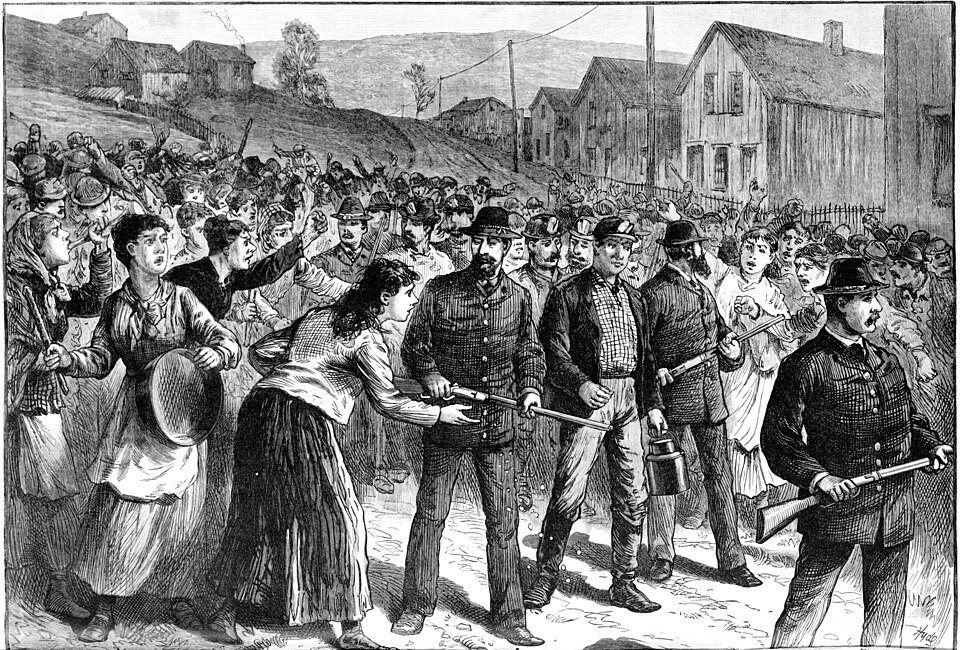
When the mine owners got wind of this, they launched a brutal crackdown. They hired armed private guards from the Baldwin-Felts detective agency to serve as spies and strikebreakers. These hired goons forced striking miners and their families from their homes at gunpoint. There were beatings, armed skirmishes and shootouts. Most infamously, they rolled out the “Bull Moose Special“, an armored train with machine guns which they fired into a tent colony of striking miners, killing at least one.
The conflict between workers and owners kept on escalating until the point of open warfare, at the 1921 Battle of Blair Mountain—the largest armed uprising on American soil since the Civil War. Over ten thousand miners clashed with a private force of two thousand private militiamen. They exchanged gunfire for days, racking up dozens of casualties on both sides. The strikebreakers even hired private planes to drop bombs on the advancing miners.
The battle ended in a defeat for the unions when the U.S. government sent in federal troops to dispel the insurrection. But it wasn’t the state that forced the mine owners to treat their workers so cruelly in the first place. It was the predictable outcome of unchecked selfishness.
Smith doesn’t even gesture at an explanation for why this kind of violence doesn’t occur in the NAC all the time. Even if it were true, as he insists, that abolishing government makes us much wealthier… why wouldn’t the property-owning capitalist classes of that world just capture all that surplus for themselves while continuing to pay their workers poverty wages? Was it out of the goodness of their hearts?
Even more baffling is his claim that only our world, and not his anarcho-capitalist utopia, suffers “financial crises alternat[ing] with war”. There are no financial crises in a completely unregulated economy? No recessions? No depressions? No Ponzi schemes? No bubbles that inflate and burst? Does Smith think the state causes bank failures?
In reality, a laissez-faire market would regularly see bank runs, panics, busts and crashes. That’s supposed to be how it works in a free market—the good actors thrive and the bad ones go out of business. It’s just that, when you’re dealing with banks, “go out of business” means that people lose their life savings. That’s what the Great Depression was, so it’s puzzling that Smith treats it as something unique to our world.
The Battle of Blair Mountain and other anti-union violence (like the Ludlow Massacre) shows that not all violence can be blamed on the state. The capitalist class through history has been equally willing to shed blood in service of their real or perceived interests: working their employees to exhaustion and breakdown, forcing them to labor in deadly conditions without relief, and when they protest, hiring other men to kill them.
Even when it would be a trivial expense to treat their workforce better, they’ve repeatedly shown that their greed is limitless, and they’re willing to commit any evil to keep feeding it. As Smith puts it: “swallowing lives, fortunes, destroying sacred honor, screaming in its bloatedness for more, capable of any deed—no matter how corrupt and repulsive”.
Image: Pinkerton detectives escorting strikebreaking scab miners to work, via Wikimedia Commons

New reviews of The Probability Broach will go up every Friday on my Patreon page. Sign up to see new posts early and other bonus stuff!
Other posts in this series:
I don’t doubt that Smith thought the state caused market failures. That has been a standard anarcho-capitalist explanation of the Great Depression: blame it on the Fed, then claim FDR’s policies drew the issues out. I’m not aware of how they explain those that occurred prior to the Fed or similar policies. You’re dealing with a true believer here, so don’t expect more.
Ya beat me to it, thanks. I’ve heard several libertarians (or some other faction of loony-right economic-policy “thinkers”) saying the Fed caused the Great Depression, by doing…something that they’d done AFTER the Depression began, but before the 1929 stock-market crash. It’s a Big Lie that’s knowingly crafted based on the (false) popular notion that the Great Depression began with the Crash of ’29. This careful deliberate crafting proves they know they’re lying, not just mistaken or ill-informed.
I don’t know if it has been mentioned or not but Smith seems the sort who thinks that without a national bank things would just work out. Banks would occasionally collapse but without a central federal government each bank would be small enough that it’s collapse wouldn’t matter on a large scale. That banks borrow money from other banks and the collapse of a heavily leveraged bank can set off a chain reaction is something he would ignore.
He probably also imagines a hard tie of currency to gold, which would somehow limit the problems. This changes which problems are common but it doesn’t add or remove any.
Yes, he likely did as those are u ubiquitous views among them.
I once read an article on the 1917 East St. Louis Massacre; white racists drove through a black community wildly firing their guns, so the community banded together to arm themselves and organize a community defense. This attempt at self defense was itself exploited by the racists as a provocation and excuse to mobilize an enormous mob to massacre civilians, women and children.
The State eventually intervened, National Guardsmen arrived (and chose to side with the white racists) to ‘resolve’ the pre-existing conflict (evilly and unjustly). The ‘grassroots’ justified self-defense efforts were completely insufficient against a larger disorganized offensive, much less an organized State offensive. The unofficial channels of communication allowed wild racist inflammatory rumors to spread, and the official channels of State communication eventually dampened the fires of overt violence.
Does this Libertarian imagine that organizations of States are the fountainhead of human bigotries and ethnic hatreds? That without modern organizations of States, that always everywhere the weak would prevail over the strong, the just over the unjust, the multicultural over the racist?
I don’t quite get your argument here. First you say that the state’s intervention made the violence worse and guaranteed victory for the bad guys, and then you imply that it’s unrealistic to think the good guys could have won if that hadn’t happened. At least cite President Eisenhower sending troops to Little Rock to protect black students against segregationists if you want to make the point that the state is not the source of all bigotry. But are you claiming that bigotry arises spontaneously and is not enforced through indoctrination with the justifications for it to continue? But I don’t k is about libertarians, but anarchists oppose all hierarchy, not just the state, so they would be actively anti-racist.
But are you claiming that bigotry arises spontaneously and is not enforced through indoctrination with the justifications for it to continue?
I don’t see them claiming any such thing. But it is pretty obvious that the indoctrination you speak of has been coming both from the grassroots (people teaching their kids to hate like them); and from propagandists and rabble-rousers inciting hatred to serve whoever is paying them. It doesn’t come all or mostly from the state, so abolishing the state wouldn’t make it go away.
…anarchists oppose all hierarchy, not just the state, so they would be actively anti-racist.
Sounds nice, and I hope you’re right — but the latter does not logically follow from the former. A bunch of flaming racists can oppose any hierarchy that tries to get them to cooperate peacefully with the people they hate.
Uh, it does logically follow. If a group of flaming racists oppose any hierarchy that tries to get them to cooperate with people they hate, that doesn’t change the fact that _they are imposing a hierarchy on people they hate_.
But what actually confused me about WB Whiting’s comment was the claim that anarchism requires a belief that the weak will always prevail over the strong without a state, when no anarchist has ever claimed this.
“the claim that anarchism requires a belief that the weak will always prevail over the strong without a state”
The Libertarian Author L. Neil Smith imagines a utopian world where the very monkeys and dolphins talk to us and join in society with us, and the only thing that he thinks is different is that there is no State. So he imagines that the presence or absence of the State means the presence or absence of racism/ multiculturalism, of injustice/ justice, of might-makes-right/ harmony.
The American state in 1917 was extremely racist and unjust, and its reaction to the rioting was: dispatching National Guard, which briefly increased the racist violence before putting a stop to the overt violence. It belatedly suppressed further violence and made some inadequate restitutions with with later hearings and trials.
So the multiple effects of the exercising of State power, even in this immoral and unjust manner, was still overall an improvement over lawless racist mobs who could have continued massacring innocents until they ran out of minorities, if there were no larger organized power to ever step in and put a stop to them.
The Libertarian author seems to imagine that bigotries are ‘top-down’ and at the will of a state, not ever ‘bottom-up’ and suppressed by a state. “Exclusively human” If only there were no state making us racist the monkeys and dolphins would talk to us!
And if the American state in 1917 had allowed nonwhites to vote, I’m sure their response to the unrest would have been much more just and sane than it was in the event. So the problem is not that states are bigoted and violent because they’re coercive; it’s that an UNDEMOCRATIC state is more likely to be bigoted, violent and unjust.
Hm, maybe Win’s world really isn’t supposed to be ours, what with the explicit dictatorship and now the drab fashion.
I wonder why they are so shocked that there was a War of 1812. Smith hates the Federalists but doesn’t seem to know that the Federalists opposed the war and everyone else supported it, and the reason for this was that Britain was continually provoking the US especially by way of impressing sailors. I doubt the British government would respect the North American Confederacy any more than the United States, especially after the coup d’etat against Washington.
I also clash with Smith about how simple the solution is; I’ve stated many times here that it isn’t as simple as just “get rid of the state, and a thousand flowers of peace bloom.” As long as hierarchical authority persists, you’d get atrocities like Blair Mountain. Indeed, Smith refuses to acknowledge that capitalism is violent by its nature.
What are “tubular” clothes? Like, omigawwwd, totally tubular?
Also, I was alive and wore clothes in the 1970s. There was a lot of brown, burnt orange, brick red, regular orange, and olive green*, often in loud paisleys and plaid and houndstooth patterns. Those colors look hideous on me, and I’ve got years of really unfortunate school pictures that decade to show just how awful they were. The “best” was a mint-green (which is a fairly neutral color) polyester pantsuit I wore in 1976’s school picture–I know because it was the bicentennial year and for that reason, everyone’s school picture that year had us posing with a little liberty bell. I tended to be the queen of ivory because at least it didn’t make me look like a zombie that had been awake for a week.
* The 1980s with the black, white, and neon colors came as such a relief after the drab, dull 1970s.
Another view of West Virginia:
I got my undergrad degree in Baltimore, and my college roommate was born and raised in Baltimore. Baltimore back then was very much a blue-collar city–the steel mills and fighter plane factories pretty much closed for good in the 1970s and the bio-tech and tech companies weren’t yet a thing. After graduation, my roommate went on to get a master’s in English and then take a job at a Christian college in W. VA. She took it because it was only about a 2-hour drive back to Baltimore, so she could return home for family events yet was adulting in her own place.
She didn’t last long there. She had a volunteer job in the town high school tutoring the kids, and the poverty and incuriosity just wore her down. Every kid was on food stamps and welfare and free lunch; many of the high school girls had children of their own, also on gov’t assistance. None of the kids had ever even made it as far as the nearest big town of Wheeling (20 minutes away) or been Pittsburgh–not even the zoo (40 minutes away). The families were 100% dependent on the federal gov’t for survival, but they were all anti-gummint. Lots of Confederate flags and t-shirts even thoug W. VA was on the Union side. The people didn’t know their own history and they didn’t care. Even the college kids were dull and incurious.
But Smith’s government-free history features atrocities like what happened to the largest city in the NAC:
“Little village off the East Coast – one gang decided they’d try running things, four or five other companies objected. Before the dust settled, they’d nearly wiped each other out. Manhattan, if I recall correct. Ever since, security outfits and their insurance companies have been big supporters of adjudication.”
Is Smith from the midwest or south, where bashing New York City is an obsession, or is this just his libertarian obsession showing? As of 1800 the population of Manhattan was approximately 60,489 residents and from then on started to really boom in population. Those people were living on an island approximately 22.7 square miles (59 square kilometers) small. (Thanks, Wikipedia!)
Of course the place would be a good settlement place; an island with fertile soil, good rainfall, not as snowy as Canada, miles of coastline to catch sea life and set up port for shipping up and down the east coast and also to England and the rest of Europe, and plentiful game while you’re waiting for the crops to grow. As an island, it was fairly easy to defend because you could see invaders coming across the open water. In other words, it’s a reasonable place for people to settle.
L. Neil Smith came from Denver, Colorado like me. I don’t know that New York City is particularly despised here, so it’s probably his politics. Of course, he’s from my parents’ generation so that may have been different in those days (particularly for those with right-wing views).
Just as a note, this book was written in the 1970s—the height of disco and punk rock. Say what you will about that era, I don’t think everyone wore “uniformly drab” clothing.
Maybe Smith was thinking of stereotypical Soviet Russians wearing drab clothing from drab state stores standing in long lines at GUM stores in a drab Socialist/Communist world?
Oh, good point. The Soviet-era clothing for the average person tended to be drab and uniform. In the USA, not so much.
Even more so the Chinese of that era, who didn’t appear to wear anything but the Mao suit.
Perhaps in his alternate US it’s meant to be more like them, a sign of its dystopian nature.
I think you’re right – Smith is playing it both ways, remember: Win must come from a world very similar to ours in order to be a good reader-surrogate to experience the overwhelming contrast with how good the NAC is, but also Win comes from a world where cars are outlawed, clothes are drab, the State is oppressive but criminals are coddled. Think of it this way – Win is a special sort of “reader-surrogate” – a surrogate for the reader who *feels* oppressed, and thus sees the description of Win’s world *as a realistic description of ours*
I think you nailed it.
Were cars outlawed? Makes it odd that Ed could talk about how everyone’s driving around in them without getting sued. Apparently the problem is that if we left it to the public to sue polluters instead of government taking action, that would be more efficient and … ah, I got nothing.
From an earlier chapter:
” “Tell me, how long does an American work to buy a car?”
“He can’t, any more. We used to spread it over a couple of years, why?””
I may have jumped to the conclusion that cars are illegal. Maybe its just illegal to buy them, not to have them, or just incredibly difficult to buy them, because no company in the US still makes them?
Andrew thanks. I suppose it could mean nobody can afford one because of the crushing hand of government wrecking the economy or that the government’s requistioning all the metal and rubber for its own use. Or that Smith just tosses lines off without putting any thought into them.
Offhand, I’m guessing cars are outlawed by commie environmental extremists — who, as we all know, hate cars, hate the open road, hate freedom, and hate America (all of which cars have been advertized to represent at least since WW-II).
In the earlier chapters, when he was investigating Vaughn Meiss’ murder, Win made a mention of “travel permits” and that only certain people are entitled to have them.
I’d guess you can’t own a car in his dystopian world unless the government likes you.
This is a response to Whiting, since we have reached the reply limit again.
Sure, I’ll give you that about Smith. It isn’t true of other people though. (I myself argued that it is not the case. That’s all I want to be made clear.)
Brendan Rizzo @9 I wasn’t aware Adam imposed a reply limit, the only FIB poster that does as far as I am aware is Mano, although even he doesn’t seem to be enforcing it at the moment.
I didn’t have the ability to reply in the original thread. So I had to start a new one.
Apologies I misunderstood what you were saying.
Oh, he is enforcing it, just not with any pretence of consistency or transparency.
https://freethoughtblogs.com/singham/2026/01/08/another-day-another-murder-by-ice/#comment-5514803
The above has been interpreted as a *complaint* (which it was not) rather than an observation of fact.
And on that basis, I’ve now been banned, thus proving me correct. /shrug/
A shame, as Mano’s blog is one of the highlights remaining at FtB, and the majority of commenters there are thoughtful and valuable.
But as I have invariably observed – his gaffe, his rules. I’ll still be reading for what it’s worth – can’t ban me from doing that.
Mano banned you for that?! He had a reason to ban me, but this is kinda ridiculous.
AFAIK this is not like him. I hope he’s okay.
Call it karma, mate.
https://freethoughtblogs.com/singham/2025/03/27/israeli-snipers-targeting-palestinian-children/#comment-5419993
I thought of the Soviet/Chinese uniform look too. This Wendy’s commercial riffs off the idea: https://www.youtube.com/watch?v=FpypTXccG2I. But it’s hard to see a dystopian government what, a decade after Winn wrote this, doing the same thing; his whole point, after all, is that democratic American government doesn’t work, not that the threat is a Soviet-style dictatorship.
Possibly he’s referring to the fact that men’s business wear is pretty conservative — but that hardly justifies such a sweeping condemnation. And has there been any sign of Earth-Confederacy being wild in its fashion sense? I can’t think of anything outside the chimp cosplaying as a Mexican.
Possibly, but blah conservative men’s businesswear kinda predates the New Deal.
True, but that wouldn’t make him criticizing it any less valid (though it’s still a stupid moment).
Adam, “travel permits” sounds less like a restriction on cars and more on movement: “Your license plate says North Carolina. Papers please, with authorization for travel to Atlanta.” and the like.
As I said earlier that still undercuts Smith’s supposed point that even the modern American government as it really exists is an intolerable burden on liberty — from the sound of it, it’s something considerably worse. But as these posts and comments threads are demonstrating, we’re putting more thought into the worldbuilding than Mr. Smith did.
Wanted to add that recent events reminded me of a minor plot point that will be coming up in a few chapters. You’ll know it when you see it!