
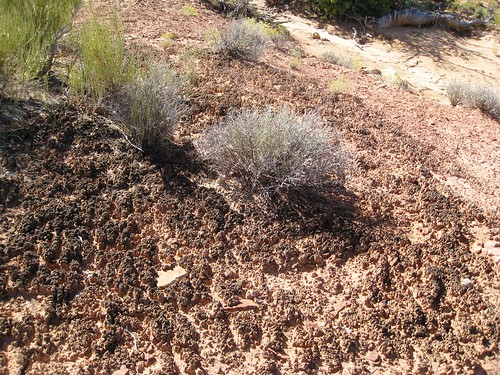
Cryptobiotic soil crust in Utah | J. Brew photo
The Palm Springs library talk last week went well: reasonable crowd given the venue, lots of good questions, and though they weren’t set up for video there’s some talk of my doing a repeat even more local and I’ll make sure we get video of that, if it happens.
One of the questions that came up was about something that was related to the topic of my talk but worthy of its whole own presentation: cryptobiotic soil crusts. I was instructed to come up with an hour-long presentation on the topic and come back. I think they may have been kidding.
Cryptobiotic soil crusts, also referred to as cryptogamic soils, or just plain “crypto,” are pretty common in arid lands that haven’t been disturbed for a while. They’re alive, as indicated by the suffix “biotic”: living communities of half a dozen different kinds of organisms: cyanobacteria, green and brown algae, fungi, lichens, mosses and liverworts. The “crypto” part means that when conditions are less than optimal, the organisms that make up the crust can go dormant, seeming to die off — “hiding” their life. Cryptobiotic.
The crusts develop in places where there isn’t enough moisture to maintain a soil vegetative cover: no trees, no sod, no leaf litter, no humus. They usually start with filamentous cyanobacteria, which grow mats similar to fungal mycelia penetrating the top inch or three of soil. Cyanobacteria photosynthesize and many of them fix nitrogen, so all they need to grow is water and a few soil nutrients. When it’s wet they extend their filamentous sheathes into the soil, which is exactly as sexy as it sounds, and then when the drought comes the cyanobacteria shrink back but the sheathes — made of polysaccharides, mainly — stay behind.
Sometimes the crusts begin with green algae instead of cyanobacteria, often in places where the base soil is more acidic. Sometimes the two foundational phyla coexist, and sometimes a crust’s bedrock filament mat will shift from one to the other if soil pH shifts. Over time an entire swath of soil can become riddled with the filaments, and other organisms colonize them. Lichens are common crust inhabitants, as are free-living fungi, and the fungal hyphae from both add to the sturdiness of the crust. Mosses often join the cryptobiotic crust community, as do liverworts.
In cold deserts, these crusts can form pinnacles six or eight inches high. In hot deserts like the Mojave, the crusts are usually bumpy surfaces, with about an inch or maybe two of relief, and in the Sonoran and hotter deserts, they’re flatter.
The bacterial/algal/fungal “root” system of these crusts is really good at extracting nutrients other than nitrogen from the desert’s mineral soil, as well as stabilizing that soil against wind and water erosion, and holding onto soil water with those polysaccharides. As you might guess, this makes the crust a good place to germinate if you’re a vascular plant seed — assuming you can penetrate the crust to do so. Crusts often serve as nurseries for bunch grasses, annual plants, and even long-lived shrubs, whch benefit from the water-retention and nutrient-extraction services the crusts perform.
Crypto also serves an air quality control function: it’s a dust trap. Particulate matter ranging in size from smoke to sand lands on the crust, falls into its fractal surfaces, gets trapped by filaments. The crust adds the particles’ biological and nutritive distinctiveness to its own. That helps fertilize the surrounding shrubs.
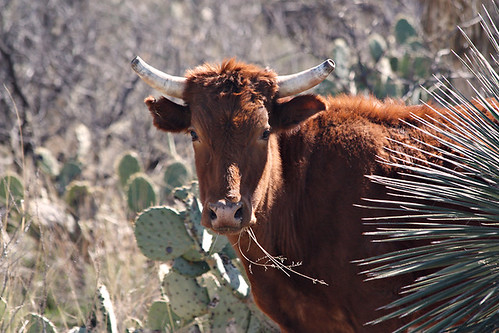
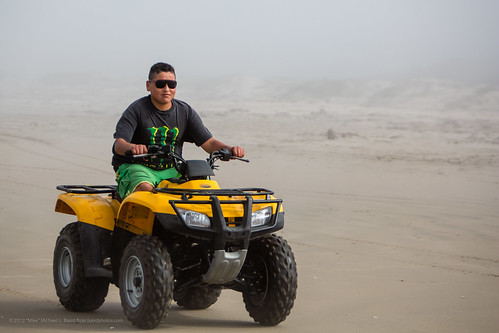
The bad news is that this crust is fragile. Really fragile. A careless step by a 95-pound human in tennis shoes can do damage that takes a century or so to heal. If the desert’s main problem was 95-pound tennis players stepping on it, that might be a manageable level of damage. But there are several different vectors of more significant physical damage we’ve unleashed on cryptobiotic crusts in the past, including:
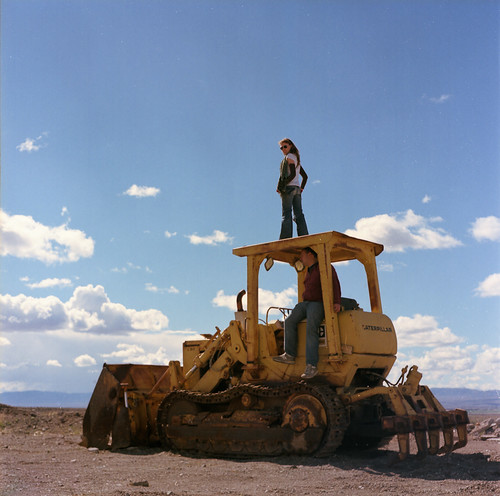
Once damaged, the speed at which a crust regenerates varies. If it’s only a footprint-sized gouge, the cyanobacteria might well rebuild a filamentous mat within a decade, rain permitting. The full complement of lichen and moss will take longer. And if the damage is so widespread that there’s little cyanobacteria-algae-fungus-muss inoculant left in the area, it could take a lot longer. Millennia.
One last thing that organic mat of microorganisms and tiny plants does: it sequesters carbon. Polysaccharides, after all, are just carbon dioxide turned into sugar and then polymerized. The amount of CO2 an acre of healthy desert sequesters each year is a hot topic in desert ecology over the last few years, with some good scientists saying “a lot” — as much as 100 grams per square meter in the Mojave per year — and other good scientists saying “wait a minute, let’s see some better data and some explanation of where that carbon actually goes.”
But it’s certainly more than “none.”

We got a lot of this in southern Utah where I go to recreate, mtn bike, hike and whatnot. It seems like there used to be more awareness about not stepping on it, but now no one seems to mention it anymore and I see people plod across without a thought.
Reading the first part, my first thought was that this might have some utility for desert farming. But I guess the fragility rules that out.
Given the apparently slow growth, I tend to be skeptical of the value as a carbon sink. I’m not sure how it could gather so much carbon if it expands so slowly.
Thanks, Chris, for the interesting article. I remember reading a warning, a long time ago, which read, “Don’t step on the cryptogam!” I don’t remember where I was, but I think it was at high altitude. And now, after all those years, I know what cryptogamic soils are.
Are these able to take hold in dry lake beds? (i.e., those that are wet maybe every 3rd year or so) I suppose I don’t notice these crusts in dry lake beds (or stream beds) or dunes. But for those who see nature as a jungle gym and not a theater, I wonder if sticking to dry lake beds will do the least damage..
ATVs… I hates them.
I remember when I was living in the desert, this was a constant topic of legal and policy battles.
Unfortunately, most of the arguing was in regards to people using ATVs on private land – other people’s private land, people who did not want ATVs on their land. I have no idea what the outcome was, I was just disappointed that this was even an issue (destructive use of someone else’s property without their permission should not be legally protected).
I get that they can be fun, but so many people fail to see how destructive they can be, especially to a fragile ecosystem like the desert.
I also remember being appalled at the number of ‘offroaders for bush’ or similar I used to see on vehicles.
I just hope the deserts and other fragile areas can hold on long enough until dwindling petroleum supplies render such destruction prohibitively expensive.
Cryptobiotic. Sounds like my husband on Saturday mornings.
Until you got into that whole bit about mycelia and polysaccharides and slow growth. :) Very interesting stuff, thanks for this.
Very glad the talk went well, although too bad you couldn’t get video :( – maybe next time! Looking forward to more desert education.
Cryptogamic seems to be a bit of a misnomer. Yes, the component lifeforms in this soil have spores, but so do the species of mosses and ferns growing in the temperate rain forest I live in.
The hidden life aspect referenced by cryptobiotic seems more definitive to me.
@pinkboi, Speaking as one who does see nature as a jungle gym, it is possible to go into the desert and hike and climb without stepping on the crust. You stick to the trails. There are also lots of areas with slick rock for hiking and climbing. It’s actually fun to move around from rocky area to rocky area without touching the sand. Sometimes you have to double back. Sometimes you have to JUMP. Kind of a meta version of “Step on a crack and you’ll break your mother (nature’s) back”
It’s a matter of acting responsibly. And yeah, we probably do some damage anyway. The big problem is there are too many people. And despite being the first generation to really understand that there was a population problem, the baby boomers conveniently forgot about it when they came of age and bred with abandon.
That first pictures looks like the fields a year after the city sprays sewage sludge. Interesting stuff.
um…so what?
It’s not a misnomer.
Awesome read. Thanks.
pipenta:
That’s demonstrably true, but far more damage has been done by the culprit in PZ’s first photo, and its ungulate kin. There are very few, if any, areas of cryptogramic crust that have escaped thorough trampling by livestock, beginning with the Spanish entrada.
Speak for yourself. I’ve selected myself out (hence my ‘nym). The buck stops here.
Me:
Sorry Chris. You need your own FtB blog!
About twenty years ago, I read that someone had finally looked at the 1-mm-thick crust that forms on ordinary sand when it’s not disturbed, and found complex ecosystems of microscopic bacteria and algae–perhaps a precursor to the more obvious ones here.
Here are some nice images of what Chris is talking about.
great interesting article and intriguing subject. I hate the ignorant destructive nature of what we humans have done and still do but the processes have not been destroyed.
This particular event of algae to soil humus to vascular plants illustrated here could happen anywhere the same or similar circumstances would happen correct? Not much moisture but enough moisture for long enough for the algae to grow and start the process otherwise there would just be sand or dry mineral soil.
Is this found in other continents or just in North America or in the western hemisphere.
Since one of the elements needed is the soil being undisturbed if here one of the disturbing elements are animals, actually the only things listed above are just 2 animals though I assume horses sheep and burros are included. Would the distribution of these soils be effected by other animals like rodents?
Would these types of soil/life have been part of the first processes that occurred as live began to colonize the land areas of early earth in the drier areas?
Sorry but if I had one real regret at all is that there is not enough time or enough personal energy to answer all the questions that come up all the time.
uncle frogy
Good stuff, Chris! I saw some of this soil on the “Sound of Silence” trail in Dinosaur Nat’l Monument near Vernal, Utah. Signs caution you to stay on the trail and not step on the living crust.
Dinosaur Nat’l Monument
I also something that might be cryptogramic crust up in Denali Nat’l Park:
Denali soil
Thanks for this great explanation. Some other useful references:
An Introduction to Biological Soil Crusts
and
A Field Guide to Biological Soil Crusts
I could not find it for sale but it is avalable as online
A Field Guide to Biological Soil Crusts of Western U.S. Drylands: Common Lichens and Bryophytes By Roger Rosentreter, Ph.D., Matthew Bowker, Ph.D., Jayne Belnap, Ph.D.
J Brew
PS – glad my photo was useful
Thanks John, it’s a great shot — though it makes me want to go there, which is distracting.
There are hard copies of Rosentreter et all around: I got one about a month after it came out as a review/sample. But the PDF is as good.
Really enjoying having you on here Chris, a perfect foil for some of the (sadly necessary?) more vitriolic threads. There are some gorgeous soil crusts here in Oz, particularly in the mallee country. It is truly a treat if you are lucky enough to get first rains of the season over night and just lie with your nose on the surface watching an entire microcosm come to life. Ain’t life grand?
More:
* sandy crusts
* cryptobiotic soil crusts
* Salt Basin dunes with cryptogamic crusts, near the Guadalupe Mountains. Do not get lost: you will die. Lock the gate and leave the key at the visitor’s center when you depart!
“PUBLIC-LANDS RANCHING IS A MAJOR THREAT to cryptobiotic crusts and nearly all Western U.S. plant communities. Cattle strip vegetation and leave only the most inaccessible crevices untrampled. Cryptobiotic crust cover on public land is often measurable only in square inches, usually under shrubs or in cracks between rocks that are too steep for cattle. Well-developed crust communities flourish only where cattle are excluded. The ranching culture perpetuates several myths about crusts: vast areas of desert are thought to be “naturally” devoid of crusts, and crusts may be deliberately destroyed because they “compete” with grass or “prevent” grass from growing.” –Just like everywhere else, when we stop interfering the natural ecosystem comes back. For a dramatic example, look at the wildlife in “no man’s lands” such as the border between North Korea and South Korea.