Not at all, those are the sexual organs of the tree. The promise of new life etc. What did they teach you in science class?
(As Dr. Getafix will tell you, the sap contains the essence of the mighty oak. If you want supreme strength, you need to make a potion using this stuff.)
I got curious about mistletoe evolution, since it’s not so obvious how a plant would begin putting its roots into a limb high above the ground. First, it should be noted that there are various “mistletoes” (five clades are known, I believe) that have evolved independently, then it seems that most, if not all, began as root parasites:
How did mistletoes become aerial parasites? Two scenarios seem possible. Firstly, they could have climbed trees first, then become parasites. In other words, mistletoes could have evolved from free-living ancestors which were epiphytic on tree branches in humid forests. Alternatively, they could have become parasites first, then climbed trees. In other words, mistletoes could have evolved from terrestrial root-parasites by somehow adapting as parasites on tree branches.
All of the available evidence supports the second hypothesis. Among the order Santalales, to which the different groups of mistletoes belong, the least specialized, presumably ancestral members are free-living trees and shrubs. However the order also includes derived genera which are terrestrial root-parasitic trees and shrubs…
If you ever pick some of the white berries of mistletoe and squeeze them between you fingers, your find the reason the Pagan Europeans considered Mistletoe a fertility symbol. The sticky thick white berry juice will make you grab for an old sock to wipe it off! Birds eating the berries also get that feeling, but they have to use a tree branch.
Antiochus Epiphanessays
You have warmed my cold and stony heart, you rascal.
Glen Davidson:
First, it should be noted that there are various “mistletoes” (five clades are known, I believe) that have evolved independently, then it seems that most, if not all, began as root parasites.
Astute. All five clades arose from root parasites in the order Santalales*. The phylogenetic basis of that statement can be found here:
Nickrent, D.L., V. Malécot, R. Vidal-Russell, and J.P. Der. 2010. A revised classification of Santalales. Taxon 59(2): 538-558.
*Completely happenstance that the Christmas misteltoe belongs to such a festively named order. Sandalwood (Santalum) is a parasitic tree of this order.



Woo and yay :D My favourite holiday plant!
So, did you decide to post a picture of Mistletoe before or after picking Holly’s entry for the day’s atheist post..?
So, first a post from Holly, then a post about mistletoe…
I see what you did there!
/@
Hmm. Subtle hint? Looks like PZ wants a kiss.
Festively parasitic, eh. Yes, quite darned pretty. And religion can be pretty too, but they’re both parasitic, & poisonous.
@ OP
Not at all, those are the sexual organs of the tree. The promise of new life etc. What did they teach you in science class?
(As Dr. Getafix will tell you, the sap contains the essence of the mighty oak. If you want supreme strength, you need to make a potion using this stuff.)
all hail Satan Claus!
You mean Easter season?
Glen Davidson
I got curious about mistletoe evolution, since it’s not so obvious how a plant would begin putting its roots into a limb high above the ground. First, it should be noted that there are various “mistletoes” (five clades are known, I believe) that have evolved independently, then it seems that most, if not all, began as root parasites:
More at http://www.anbg.gov.au/mistletoe/evolution-origin.html
Unless, of course, the Designer, praise his name (whatever it is, hee hee), of P. falciparum as thoughtfully designed plant parasites.
Glen Davidson
A nod to The Golden Bough – with a nod to Sir James Frazer.
And speaking of parasites…
Mistletoe (Phoradendron serotinum) is also the State Floral Emblem of our beloved state of Oklahoma. How appropriate.
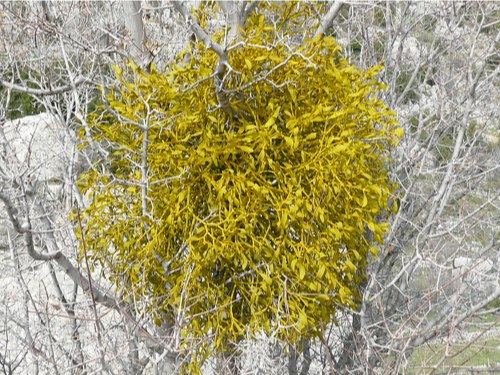
Why isn’t it green and where are the white berries?
Balder! Duck!!
I would have thought that the seasonable parasites would look more like clergy.
My favorite part about mistletoe are the insects that rely on it, such as the Kiss-Me-Now Weevil.
If you ever pick some of the white berries of mistletoe and squeeze them between you fingers, your find the reason the Pagan Europeans considered Mistletoe a fertility symbol. The sticky thick white berry juice will make you grab for an old sock to wipe it off! Birds eating the berries also get that feeling, but they have to use a tree branch.
You have warmed my cold and stony heart, you rascal.
Glen Davidson:
Astute. All five clades arose from root parasites in the order Santalales*. The phylogenetic basis of that statement can be found here:
Nickrent, D.L., V. Malécot, R. Vidal-Russell, and J.P. Der. 2010. A revised classification of Santalales. Taxon 59(2): 538-558.
*Completely happenstance that the Christmas misteltoe belongs to such a festively named order. Sandalwood (Santalum) is a parasitic tree of this order.