
It’s all Matt Dillahunty’s fault. He tells me he’s carrying on a correspondence with some guy who claims to have an alternative theory of evolution, and asks me to help him wade through the gobbledygook…so I did. I just didn’t realize how much gobbledygook there was.
The guy is named Eugene McCarthy, and he calls his alternative “Stabilization Theory”. Apparently he does have some scientific background and has studied hybrids in birds; the problem is that now he sees everything in terms of species hybrids. And I mean everything. I downloaded his book — it’s free — and skimmed through all 400 pages.
Oh, man. It was like a timewarp.
The first half of the book is a total snooze. It’s endlessly wordy, tedious rehashing of basic genetics — polyploidy, heterosis, karyotypes, yadda yadda yadda. There’s nothing novel there at all, and if you know any basic biology at all, you can skip it. If you don’t…well, there are more lucid texts you can read. He sets up various controversies, but they’re all ancient history: he goes on and on about Darwin’s work with pigeons, the saltationist-gradualist debates (no, not the recent ones — this is stuff from like 1910-1920), and approvingly cites Arthur Lovejoy (!), author of The Great Chain of Being, and other authors from the 1930s-40s as if their concerns were current. The first part is the kind of book I can imagine being written in 1940 and being taken semi-seriously before being forgotten…and here it is being written in 2008.
And then it starts getting weird.
His theory is rather like Goldschmidt’s saltational theory of systemic mutations that produce abrupt transformations of form…except Goldschmidt was a piker. McCarthy claims to have a mechanism for producing those kinds of mutations. Sure, the familiar point mutations we know about in molecular biology and genetics occur, and genes can gradually change, but these changes are independent of speciation, and in fact have nothing to do with the kind of evolutionary change we see in the fossil record. Instead, the only things that can produce the morphological changes we observe are large-scale genetic changes, like polyploidy and hybridization.
He pooh-poohs Darwinian trees of descent, like the one on the left in this diagram. That’s not how evolution occurs, he claims; it’s like the diagram on the right, where every novel species is produced by hybridization between two species.
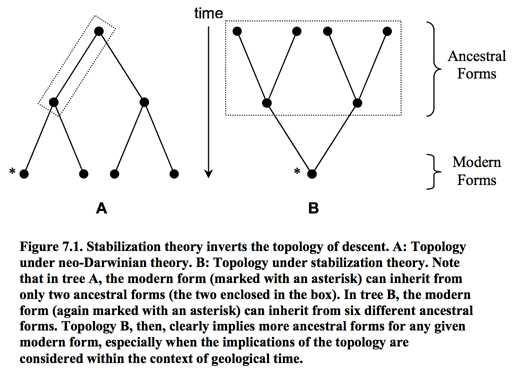
He doesn’t like the concept of adaptive radiation, where a lineage branches and diversifies. It doesn’t happen, he claims; instead, it’s more of a combinatorial phenomenon, where different species hybridize to spawn novel, stable forms nearly instantaneously, which will then persist unchanged for long periods of time until there is another hybridization event.
It doesn’t seem to register on him that if every species were the product of two parent species, then that would show up in the genome — that modern molecular genetics would rather readily test his hypothesis. That’s no problem, though, because like I said, this book is in a timewarp from an age before molecular biology. It isn’t on his wavelength at all.
Actually, data isn’t much on his wavelength. Near the end of the book, we get to specific examples, and he chooses to discuss the origin of mammals. You know that conventional theory, where mammals arose in the Mesozoic and underwent a rapid adaptive radiation to fill niches vacated by the extinction of the dinosaurs in the Tertiary? Nonsense! Didn’t happen!
His alternative explanation is that the dinosaurs did not go extinct, but instead there was a kind of combinatorial reshuffling of species via hybridization that produced new forms.
“Say whut?”, you’re thinking. What does that mean?
He gives examples. Look at the Mesozoic ankylosaurs: squat, armored herbivores. Now look at Tertiary armidillos, especially things like the extinct giant glyptodonts. They look kind of similar.
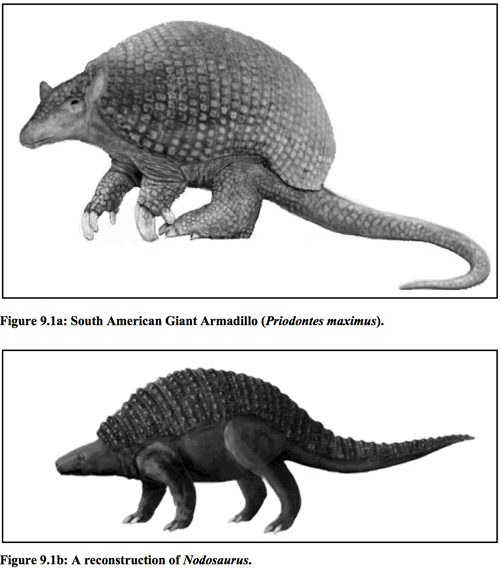
Therefore, says McCarthy, ankylosaurs evolved into armadillos. And pangolins are the descendants of stegosaurs.
The modern giant armadillo is so similar to the ancient ankylosaurs that it is only reasonable to suppose it is descended from them. The same is true for pangolins and stegosaurids (although the case is somewhat weaker because the exact external form of stegosaurids is a point in dispute). These similarities strongly suggest that two of the most common “dinosaurs” of the so-called Age of Reptiles—ankylosaurs and stegosaurids—were in fact mammals, and, even more remarkably, that their direct descendants exist even today. So in their cases, it seems, there was no “extinction of the dinosaurs”—there was merely a reconceptualization and reclassification (both may be cases of residual dwarfism).
So in addition to being completely ignorant of modern molecular methods, McCarthy stands stupidly in defiance of comparative anatomy. The only way to claim that an ankylosaur is an armadillo is to be utterly oblivious to any details of the skeleton.
He continues in this vein. Bats are descendants of pterosaurs. Whales came from mosasaurs. Seals are the children of plesiosaurs. Dinosaurs weren’t actually giant reptiles, they were big mammals. These ideas are contrary to all of the evidence, of course, but one thing you’ll learn from this book is that the evidence doesn’t have to be considered. It’s all about McCarthy’s belief in the fixity of species — species don’t change at all, ever, and all evolutionary novelty comes from the sudden production of new species by ‘stabilization processes’, like hybridization.
To me, organisms have a far greater value when they are seen as ancient and unchanging, existing today much a they did when they came into being long ago, in the remoteness of time. They become something more than mere pawns, forever changing at the behest of a tyrannical environment. When a new type of organism comes into being via a stabilization process, the primary selective factor is reproductive stability—a stable reproductive cycle must be established or the new form will fail to maintain itself in existence. If it survives, the new type spreads into all geographic regions to which it is suited and has access. If it ceases to have access to a suitable environment, it simply goes extinct. It does not gradually change into a new type that can tolerate a new environment. Under this view, a form’s genetic make-up plays at least as great a role in determining its characteristics as does the environment. In fact, it generally plays a far greater one. Once a new type of organism has stabilized, the environment may place limits on growth, health, and activities, but it does not significantly change the nature or potential of that type of organism, even with the passage of time on a geological scale. Living forms, under this view, are beyond and above the environment.
Well, that’s…different.
It’s also pure crackpottery. If you search the web, you’ll find almost no references to McCarthy and stabilization theory; I think I’ve just increased his notoriety a thousand-fold. No scientist is going to touch it, because it is simply laughable and bizarre. There are a few positive references from creationists, who like it because it defies science, but don’t see how to reconcile it with their biblical bullshit. Here’s one example, where it’s cited as a “possible crack in neo-Darwinism”:
From a perspective of Christian apologetics, the models presented by Schwabe and McCarthy do not directly help our cause, for they are but more claims to naturalism with no connection with the supernatural. But they at least lead in the right direction: humans appear suddenly, the genetic material was widespread at the beginning, the racism of evolution is denied, and individuals benefit from cooperation, not competition. And in the end, science might be better off, for perhaps the field will take off the blinders and consider some alternate theories.
You know, if creationists see McCarthy’s crap as a reasonable and viable alternative scientific hypothesis, they’re dumber than I thought.

This is just as bad as some Christian kooks who claimed that modern reptiles, like iguanas and chameleons are direct descendants of dinosaurs that have survived the fabled “Flood”. How disgusting.
So, if all species are the product of hybridization, why is there (probably (because the fossil record is (and always will be) incomplete)) far greater diversity now than, in say, the Devonian? Or the Permian? And how does hybridization produce a jawed fish from a jawless fish? Or ectothermia out of endothermia (I hope I didn’t just reverse those (but if I did, I trust y’all know what I mean?))? Or feathers out of scales?
Does it occur to these crackpots that science does take off the blinders? Science does consider new hypotheoses that might overturn the paradigm (see birds and dinosaurs, and plate tectonics) and those that can be supported with actual evidence rather than mind smoke.
Oh, I can resolve that. It’s combinatorial. Species A, B, and C can produce new species AB, AC, BC by hybridization, or AA, BB, CC by polyploidy, so you’re not going to have a decline in the number of species.
“You know, if creationists see McCarthy’s crap as a reasonable and viable alternative scientific hypothesis, they’re dumber than I thought.”
You are mixing up Dumb and deluded. Of course creationists are also willfully ignorant which has all the appearances of being dumb. It is discouraging to see otherwise clever people dedicating their lives to reconciling nonsense with reality. It is just another benefit of early religious indoctrination.
*Snorts*
Oh, that hurt.
Thank you, PZed. My liberal arts brain just made the sound of a record needle (you kids can ask someone!) dragging across a Blue Oyster Cult record.
Maybe he has something – cross a shar-pei & a naked mole rat and the result is Jan Brewer.
Well, it just goes to show that even without creationism, biology can attract its fair share of kooks. Darren Naish is a great source for some of the weirder “theories” that have been spouted by various crackpots such as the claim that humans are the most primitive form of vertebrates and all other vertebrate species (everything from sharks to elephants) were all descended from humans! Here is a link if you want to find out more: http://scienceblogs.com/tetrapodzoology/2008/03/17/initial-bipedalism/
Of course, they are also the BANDits. I’m curious, PZ, have you ever written anything on those guys?
Just caught that. When did ankylosaurs and stegosaurids become two of the most common dinosaurs? Did I miss some massive new discoveries?
If humans hybridized from chimpanzees, why are there still sexy chimpanzees? Er, um….
Yeah, I mean, without molecular biology or comparative anatomy, I guess you could look at this and say it was an interesting hypothesis. But the biological evidence is pretty unequivocal: It just didn’t go down like that.
Well, they are two of the four dinosaurs on the box of my son’s ex-favorite Mac ‘N Cheese. Of course, it’s his ex-favorite Mac ‘N Cheese now because the box also says that T-Rex ate stegosauri, and even when he was 5, that bothered him. Sounds like the marketing company did about as much research as Eugene McCarthy did.
jojo:
Mac ‘n Cheese biology. Makes sense.
Can this be any dumber than it sounds? I suspect the answer is yes! This fool seems to think that because X looks like Y is must be a descendent of Y. Well that is not necessarily true. Armadillos are clearly mammals has a comparison of various features would show, such as bones etc. Nodosaurus is Dinosaur and a bone comparison would show that it is clearly not an ancestor to the Armadillo. All this fool has is “It sort of looks like a giant Armadillo”. Sorry no cookie for you. And this person should read about convergent evolution.
This sounds a little bit like that theory that was trashed here last year,
in which some forms of metamorphosis were explained as very rare
hybridizations between widely different species–even belonging to
different phyla. Can’t remember the guy, but there was some connection
to the late Dr. Lynn Margulis as I recall.
They even start with the same letter!
it evolved to look that way because it wanted to!
Where’s my croco-duck dammit?!?
[Eugene McCarthy’s writing] is a total snooze. It’s endlessly wordy, tedious…
Must be related to Anthony.
“Science” by looking dully at something and taking your first conclusion as accurate because, dammit, it just looks that way. Design to the IDiots, ankylosaurs as ancestors of armadillos for McCarthy.
Why would anyone ever bother to move beyond first appearances, the prejudices brought to the subject?
Glen Davidson
It does provide for some comic relief though does it not? At least it doesn’t cause ire like the fucking creationists do.
“Dad, what are those two dinosaurs doing to each other?”
“Those aren’t dinosaurs, son – they’re mammals. Don’t let the scales, the cold bloodedness, and the other aspects of reptile physiology fool you. Also ignore the fact that the two species did not exist simultaneously, and we modern humans won’t evolve for a few million years yet either way. Just don’t tell your batty creationist uncle Ken that. You’ll never hear the end of it.
As for what they are doing… well you see, when an ankylosaurus and a stegosaurus love each other very much….”
Sorry. I couldn’t help myself.
I’ll go sit in the corner and be quiet now.
Maybe they were horny?
And best of all, they aren’t at all hampered by that Satanic fetish of the “materialists,” actual evidence.
Glen Davidson
The paper in PNAS was: Caterpillars evolved from onychophorans
by hybridogenesis by Donald I. Williamson.
I can see it now, cage match, a padded room, Ham McCarthey, Williamson. The winner to battle Rupert Sheldrake and his awesome ‘morphogenic field’ for the WTF title.
Urk… You know, I would think that, even for this bozo, one big question would have to come up, “Where the hell did all the species come from, to produce the hybridization, if the only means by which their diverse forms could have arisen was *from* hybridization?” Because, you know.. that seems to me to be the elep… oh, hell, lets just make it ‘brontosaurus’, in the room, with this absurdity.
“To me, organisms have a far greater value” Wait. Does that make this just wishful thinking? “I prefer it this way, so I’ll say it IS this way!” That’s what it sounds like to me. The value of organisms is immaterial.
Also wouldn’t “stabilization theory” suggest that eventually the number of species would dwindle as they combine forces into a new one? It sounds like some terrible “leading into a single PERFECT species” carp.
Although, I will give it credit for explaining where mermaids and lamia come from.
The paper in PNAS was: Caterpillars evolved from onychophorans
by hybridogenesis by Donald I. Williamson.
I can see it now: cage match, a padded room with Ken Ham, Eugene McCarthy, Donald Williamson. The winner to battle Rupert Sheldrake and his awesome ‘morphogenic field’ for the WTF title.
This explains the sudden explosion in the centaur population in Enumclaw.
Too soon?
Vinyl is still semi-popular. Highest possible audio quality, so audiophiles tend to use them. And then when people pirate music, they try to look for the highest quality, which is often ripped from vinyl and converted to FLAC.
Sorry about the OT-ness, I just get annoyed when people overestimate the ignorance of the young.
¡¡¡Ay ay ay!!! What happened to the knees of that poor Nodosaurus!?!
…Forget 1940. This is Linnaeus. Linnaeus believed that species in a genus hybridized to create individuals of each other. (This way, species couldn’t die out, at least as long as the entire genus didn’t die out: if a species category happened to become empty, hybridization of other species in the genus could easily fill it again.)
…That’s straight from the 1880s, when O. C. Marsh discovered Stegosaurus, thought the plates were shingles that covered its back, and named it accordingly (“roof lizard”). “Dispute” my ass, complete articulated skeletons have been known for decades.
PZ? I can has Comic Sans plz?
I like your way with words!
No. Both were reasonably common in some places at some times, but… no.
Erm. Of those, only the scales were present; and they weren’t the large overlapping scales found on, say, snakes.
Compared to what?
So if they look the same they are related? Like dogs & cats – 4 legs, 2 ears, tail, snout, fluffy. Must be related. Let’s see if my cat will “hybridize” with my neighbor’s dogs…
Not knowing much about biology, may I ask a question here?
Creationist (thinking of Nephy as an example) reject morphological change – which I interpret as a change in body form and/or structure. They also say that animals were all plant eaters before the Fall and became meat eaters afterwards.
Wouldn’t changing from a herbivore to a carnivore be a morphological change? The animal’s external body may look the same, but I would think that that changing the structure of the digestive system, i.e. shorter intestines, different digestive juices, different mechanisms to digest proteins, etc, would be considered a morphological change.
8-track tapes maybe?
So based on an external examination of a reconstruction of an extinct species of armadillo and an extinct herbivorous dinosaur, and apparent lack of knowledge of DNA, he’s decided mammals were created by hybridization of dinosaurs? :-/
He also fails to account for the fact that, were this model true, there would have had to have been billions of, for want of a better word, “original lifeforms”, or at least vastly more than the current number of species. You know, rather than the single original lifeform posited by neo-Darwinist evolution, a position which somewhat accounts for the staggeringly improbable occurence of abiogenesis. With his theory, abiogenesis would have had to occurr billions of times, separately, producing billions of vastly different animals, which then all hybridised to create todays species. That just doesn’t work. It creates a problem rather than solving one.
Didn’t Lynn Marguilis basically believe that hybridisation was the driving force behind evolution? And that natural selection or mutation was minor?
I remember her saying as much in a Discover magazine interview
#6:
Let me guess, “Tyranny and Mutation?”
::ducks::
Seriously though, speaking as a layperson, aren’t there some fundamental differences in skull and jaw morphology between mammals and more basal reptiles like dinosaurs? Does this crank address these at all?
Sort of; she emphasized cooperation and mutualism, in particular endosymbiosis, and she somehow managed to fall for the paper cited in comment 24.
You’re about the third person to bring this up, and it’s still wrong: see comment 3, where PZ explains it.
You’re most likely right that McCarthy has to posit at least two independent origins of life. More, however, may not be necessary: A and B make AA, AB and BB, then A, B, AA, AB and BB make AAA, AAB and so on… if everything can hybridize with everything, you get pretty fast growth of diversity.
Yes, and such differences are by no means limited to the head. Even tail vertebrae are usually easy to tell apart.
(“Basal” just means “far away from the clade I’m interested in at the moment”. It’s usually best avoided, and so is “reptile”.)
Wait, I thought pangolins were a hybridization of armadillos and pine cones. Damn, now I’m really confused.
No no. That’s the triceratops. (Which, I’m sure, is related to a modern bull, or maybe rhino…)
#37
Point taken. I think “diapsid” might have been the term I was looking for.
evidenseless science its where it’s at!
uncle frogy
It seems like a very Harun Yayaesque approach: find superficial similarities between two non-closely related species and claim it proved that they didn’t change (in Yaya’s case) or that they are descendant of each other (in McCarthy’s case).
Also:
Just because he would prefer the world to be a certain way doesn’t mean that it is that way.
Clearly the man is mad. Why, the real origin of the armadillo has been thoroughly explained by Professor Kipling:
http://boop.org/jan/justso/armadil.htm
Ogvorbis @ 22;
Well, scaled anyway… ;-P
————————————————————————————————————————–
David Marjanović @ 30;
Thanks for the assist – I have no clue what I am talking about. Then again, I don’t claim to have any background in evolutionary biology. I wonder what Eugene McCarthy’s excuse is…?
I gotta have the stats for an ankylodillo for my 1ed AD&D game.
Wow. This is seriously painful…
As for @17 noastronomer, here is a real-life (well, dead), crocoduck: Anatosuchus.
As for something with the evolutionary position that creotards think doesn’t exist, Euparkeria is morphologically and phylogenetically close to the common ancestry of ducks and crocs (also hummingbirds and alligators, and sparrows and gavials, and so forth).
Umm. Actually, that is likely only the case if, say, the original species where “optimally” different than each other to begin with. Otherwise, once you start getting things like AAAAB vs AAAAA, the differences start getting smaller and smaller, to the point where, eventually, even “small scale mutations”, would fall into the range of, “things you could get by hybridizing A^56B^23 with A^57B^23 (never mind the order of all the As and Bs). You still, eventually, reach a point where the amount of deviation from the originals just does not allow for more forms *period*. And, the less different the two originals, the sooner this happens.
Ah, the Eyeballin’ It Scientific Method. “This thing looks like that other thing, therefore they’re related!”.
Does this man have no concept of genetics? Does he think any two species can be smooshed together to make a new one that will produce fertile offspring?
I could see how this might be interesting to someone who had no idea how biology or heredity or fossils were in reality.
When I was in NYC, I went to the Natural History Museum and seeing all those fossils and skeletons lined up… With dates? You could go around and count vertebra and other very basic, and very obvious morphological features develop and constrain species development. It was something awesome I had never even thought of before, even though I knew vaguely about some of the nodes.
illyriamxo: if it’s the same Eugene McCarthy, he published a compendium of avian hybrids at Oxford University Press back in 2006. The author’s blurb says he has a PhD in genetics from the U of Georgia.
As to thinking that two species can just be smooshed together to form a new one, yes there’s a large segment of the birding community, as distinct from the ornithological community, which seems to think just that, and McCarthy may have his roots in that segment. It doesn’t help that very occasionally hybridism is the best-fitting hypothesis, pending further research. The anomolous Pomarine Skua (“Pomarine Jaeger” to North Americans) would be an example of this.
Most of my birding friends have no serious training in biology, and a lot of what they think they know comes from conversations with other birders who may not know much more than they do. McCarthy, on the other hand, has the background to know better. I suspect that he’s fallen victim to what I think of as the Lynn Margulis Effect: “When your only tool is a hammer, every problem looks like a nail.”
@David Marjanović #3
Oh of course, you’re right. Sorry, I didn’t consider that. My bad :) thank you.
I can’t believe there are actually people who believe this. This sounds like the deluded daydream of a mediocre elementary-schooler.
I know I’m late to this and there’s a good chance nobody will see it, but I just ran across something in a BYU textbook that reminded me of this:
FIgure 31.5 on page 304, as well as some of the text in the left column.
http://einstein.byu.edu/~masong/htmstuff/textbookpdf/C31.pdf
The textbook hardly mentions evolution (an extremely brief treatment is given in chapter 33), but the whole “interbred” reference looks like the author (a physicist) doesn’t understand much about speciation.
Eugene McCarthy is now thanking me on twitter for spreading the news about his ‘theory’. He’s a bigger idiot than I thought.
Reminds me of Pliny the Elder’s belief that the ostrich is a cross between a gnat and a giraffe.
More seriously, it seems that Eugene McCarthy does not believe that there is a such thing as convergent evolution. Everything evolves exactly once.