
I missed posting the Wednesday Botanical yesterday (this is happening a lot lately — seriously, people, my brain is totally fried by this semester, and it’s getting worse as I limp gasping and moaning into the final weeks), so you’ll have to belatedly make do with this:
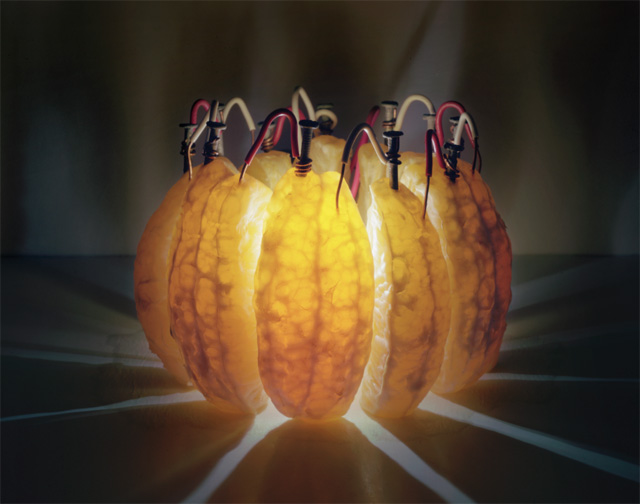
That’s an orange lit by the dim glow produced by the electrical interactions between zinc-coated nails and citric acid. It’s really dim: it took a 14 hour exposure to get that image.

Hallowe’en!
I prefer clockwork.
Pickles work better, and are much brighter.
I don’t understand. Are you suggesting a transplant of that orange, to replace your brain, will improve your cognition? Now, i can think of a few religious folk where that sort of transplant just might work.
My orange burns at both end
it will not last the night.
But ah, my foes and oh, my friends
it gives a lovely light.
Awesome!
Michael, the orange slices aren’t themselves glowing, they’re powering a light bulb at the centre.
It can replace the lightbulb as the symbol for an idea lighting up in Dembski’s head.
Glen Davidson
Yeah, the pickle thing requires applying a substantial external voltage. This photo is of the orange itself acting as a battery, no external wires.
So Florida will not become the new energy capital of North America.
I never ceased to be amazed by what even simple science and creativity can show us about the most modest of natural processes.
(Translation: Is that fucking cool or what?!)
That doesn’t appear legit to me. It looks like a computer graphic. Also, a light bulb filament so dim that it would require a 14-hour exposure would not be hot enough to be emitting in the visible spectrum.
@11: According to the artist, it’s an LED. I wish he’d provide more info on how it’s wired. It appears there’s a wire from each nail over to the next segment. Presumably on the far side there are connections to the LED.
Probably wired in series to get the necessary ca. 3.5V you need to power a white LED.
Maybe with a couple of hundred of even thousand of oranges you can get a usable light.
Ye takes yer zinc anode and shoves it in ter oranj sekshun. Then ye takes yer copper anode and shoves it in ter next sekshun. Since teh anode is wire, ye jest straight-up connex it to yer cathode for them cirkit. Jest liek a lemon or potater battry. In ceres!
Sorry, I didn’t check the original source, so I assumed (since they didn’t mention an LED) that it was the orange glowing.
Mind you, it would probably smell better than the pickle if you did supply 120V to the orange, even if it didn’t glow.
Personally I find the pickle effect more interesting, since this doesn’t sound much different than making a battery from a lemon (using copper and zinc) to light an LED. Perhaps we could create a series of christmas lights using lemons to light oranges, etc.
Dang, Roharmon beat me to it at #11. However, I would say that a filament so dim as to require a 14H exposure on the orange would produce a very red light rather than no visible light. 14H exposures have other problems (damn that physics!) – telescope cameras which can handle very long exposures typically add up numerous images with shorter exposure times.
Now is it CG as Roharmon suspects? Here a clue:where’s the shadow of the nails inside the orange slices?
OK, the guy says it was an LED rather than a filament bulb, so that could explain why the light isn’t a very dim red. However, it doesn’t explain the missing shadows of nails or the radiation pattern of the light. The 14H exposure part also requires some serious explaining.
Madscientist, the nails wouldn’t cast a shadow because of the internal structure of the orange would diffuse the light around them. The 14H exposure would be about getting a good amount of light transmitted through the orange. A fast exposure may have just picked up the LED light leaking out between the segments (which look overexposed in this shot). The internal resistance of this thing must be huge. All up a cool shot, I reckon you could improve the electrodes’ efficiency by flattening the copper and using zinc strips (or bigger nails) and arranging their spacing tighter.
I must make one of these, looks like a great party trick.
Those wires coiled around the nails have me concerned. There is far too little voltage to break down the oxides on the metals and just making a coil like that doesn’t achieve the force needed to make an air tight connection. They should have been soldered.
Also it looks like some of the copper wires coiled around the nails are in contact with the ‘electrolyte’ which would short out the ‘cell’.
Too much art, not enough applied science. Colour me dubious.
he dose not say on the site any place I could find but I wonder how many times he did this before he got an image he liked.
Artist in some ways are like a scientist in that they will make numerous experiments, works of art do it over and over. Unlike a scientist though they get to pick the results they like instead of averaging with statistics what is going on. Art is all about cherry picking the desired results.
I wanted a schematic and a wiring diagram to get a better understanding how he did it. I have seen a number of artists work I wanted diagrams and plans for to see how they did it, that kind of info is hard to find not what they do. All in all a very nice image. He makes the connection between food, light, electricity, chemistry visible in a concrete way that a lecture or formulas can not. By using food he connects it to us.
uncle frogy
A 14 hr exposure? Highly unlikely. 14 minutes perhaps, but even then, exposures of that length usually render the final image (film or digital) quite grainy-looking. I don’t see any hint of “graininess” here. A nice piece of art, however.
I’ve gone up to 4 hours on my digital with no noticeable graininess. I’m quite confident I could do 14 hours and have it look nice, though I’d have to plug in somewhere so the battery held out. If needed, do a second 14 hour dark exposure and subtract the image from the light exposure to get rid of amp noise. Also, the link doesn’t give any info about the camera used, it could be film.
My limited amateur astrophotography experience leads me to believe that has more to do with tracking error on a moving object than the camera.
Tracking is only part of it. The biggest part of taking shorter exposures and stacking is due to the fact that the longer a CCD is collecting light, the hotter it gets and the more noise it produces.
Being an astrophotographer, I can make several postulations…
I supposed it’s entirely possible the artist used a film camera, but then he had to deal with reciprocity failure. It’s also possible that he used a “dark” frame to remove the noise in post-processing. This would have required a second 14-hour exposure at the same temperature as the “light” frame. One more possibility would be that he used a purpose-built astronomical camera that has a peltier cooler to hold down the noise.
Without knowing more about the equipment used, this is all speculation. But, I too find the idea of a 14-hour tabletop exposure highly dubious without some serious post-processing. I’m sure Photoshop was involved quite a bit here.
It’s still a cool image, though.