
In my post bashing that silly article claiming to have figured out how endoskeletons evolved from exoskeletons, there was a good question buried in the comments, and I thought I’d answer it.
Are there any models pulled out of arses which explain the turtle’s unique skeleton?
Yes! I mean, no, not pulled out of arses, but there is a lot of really good and persuasive research that uses evidence to show how the turtle skeleton evolved.
First, I can see how this question popped up in a discussion of the evolution of endo/exoskeletons: the turtle shell is an excellent example of an exoskeleton that evolved in a vertebrate lineage at some time in the Triassic, so it’s definitely relevant. Also, turtle skeletons are a bit weird. The shell is made up of the animal’s ribs fused to plates of dermal bone — that is, sheets of bone formed directly by the ossification of the dermis of the skin (an exoskeleton!) rather than by ossification of cartilaginous centers deeper in the body (endoskeletons). The ribs and vertebrae are ‘endoskeletal’, formed by chondrogenesis and ossification, while the scutes or plates of the shell are dermal bone, so this structure also represents the fusion of two kinds of bone. The confusing bit is the scapula, or shoulder blade; yours, as you can tell, is outside the rib cage, but in turtles, the scapula is located inside the ribs of the shell. So somehow the ribs and scapulae in turtles have flipped their relative positions, which sounds like a radical transformation, and it’s not at all clear how you could do that gradually in evolution.
Here is a comparative diagram of cross sections of a turtle and a chicken to illustrate the difference. The ribs (r) are in light green while the scapula (sc) is in dark red. Notice how the shell makes a kind of shield over the whole turtle, with the scapula and whole shoulder girdle underneath and the forelimbs attached to it? While in the chick the ribs are the deepest bones, with the scapulae on the outside? How did that that happen?

Comparison of deep (as, serratus anterior; lsr, levator scapulae and rhomboid complex) and superficial (ld, latissimus dorsi; p, pectoralis) muscles connecting the trunk and shoulder girdle/forelimb.
The answer, as you might guess, comes from looking at how it gets that way in the development of modern turtles, because as you all know by now, developmental biology rules.
The early turtle embryo looks like a generic tetrapod embryo. The first sign of a significant morphological difference is the appearance of a thickened ridge of skin between the limbs, which eventually expands to form a ring marking the margins of the shell. This structure is called the carapace ridge (CR), and you can see it in the cross sections of embryos at two different ages below.
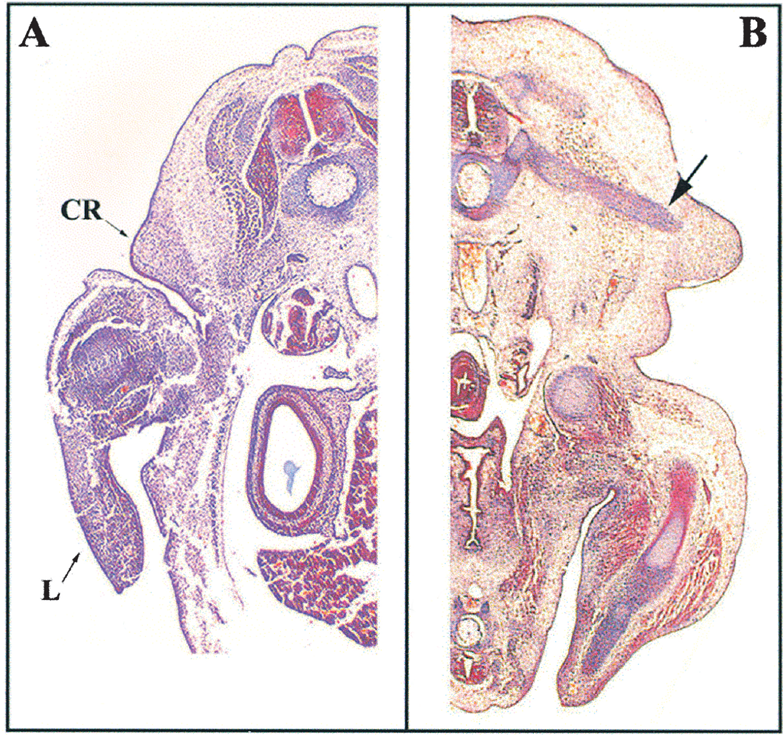
Carapace ridge and rib entry into the CR of Tra- chemys scripta. Mallory’s tri- ple stain of embryos sectioned serially on (A) day 23 and (B) day 29 of incubation. The CR has formed by day 23, but rib entry (arrow in (B)) is not seen until a few days later. The sections are taken through ex- tended limb buds (L) that can be seen for comparison.
Note that it appears as the limbs are forming (in A), but before all the bony bits have ossified — no ribs, no scapula yet. The ribs begin to grow outward from the vertebrae, and in most vertebrates they would begin to arc downwards, to wrap around the body cavity, but in turtles something different happens: they are captured by the CR and grow out to the sides. Not down, but laterally, broadening the turtle’s body. As you can see in B above, this is happening as the bones ossify, and before the shoulder girdle has fully formed.
What this means is that as the ribs grow out towards the scapula, and as the scapula extends upwards towards the ribs, where in other animals the scapula would slide upwards over the ribs, in the turtle the ribs are instead pulled up and out over the scapula.

Schematic transverse views to compare the topography of ribs, body wall (lbw), and forelimb bud (lb) with shoulder girdle between the embryos of turtles (I) and generalized amniotes (J). Generally, the amniote ribs grow ventrally into the lateral body wall, whereas in the turtle, they are arrested in the axial part (ax), growing toward the CR.
The relationship of ribs and scapula are flipped around, but notice that appropriate connections are all retained; “as”, in yellow, is the serratus anterior muscle, which attaches from the top of the scapula to the ribs in general tetrapods, and also still connects the top of the scapula to the ribs in the turtle. It’s a perfectly natural retention of other attributes of the system while one other relationship is changed.
Embryologically, this all makes sense — it’s a relatively simple shift due to a change in one tissue. But does it make sense phylogenetically? Yes — meet Odontochelys, a Triassic proto-turtle.
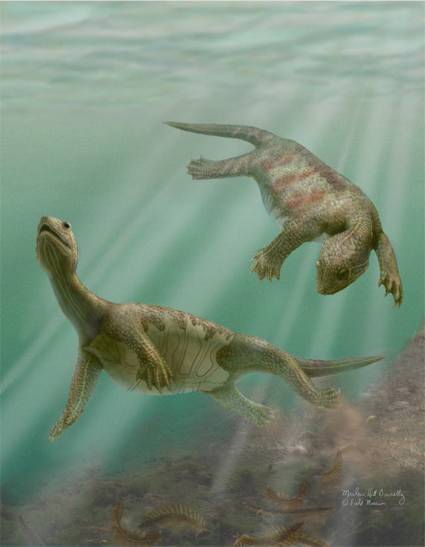
It’s a transitional form! It doesn’t have the full turtle shell, but what it does have is the broadened body plan, a flattened back with a shield-like pattern of ribs and dermal bone between the limbs, and a plastron, or ventral shell (it also has teeth, hence the name). It doesn’t have it’s scapula tucked beneath the shell; instead, the ribs/shell is pulled back. In the modern turtles, those ribs have been pulled further laterally and forward to lie over the scapula. These details are all shown in this diagram.

Evolution of the turtle body plan. (Top) A hypothetical sequence of changes in musculoskeletal connectivities. The scapula is red, AS muscle orange, latissimus dorsi blue, and pectoralis green. In Odontochelys, the AS would have connected the scapula and distal tips of anterior ribs antero-posteriorly. The pectoralis would have connected the humerus and the plastron (pl). (Bottom) A phylogenetic consideration. In Odontochelys, the CR (red broken line) may have developed only temporarily and incompletely in the embryo. In the modern turtle, the CR (red solid line) forms a complete circle, inducing the fan-shaped growth of the ribs. dc, dermal carapace.
See? Not as hard a problem as you might have thought, and all the scars of evolution remain marked in the turtle embryo and in the fossil record.
Oh, also, I just have to leave you with this really beautiful drawing of a turtle embryo from the Gilbert paper.
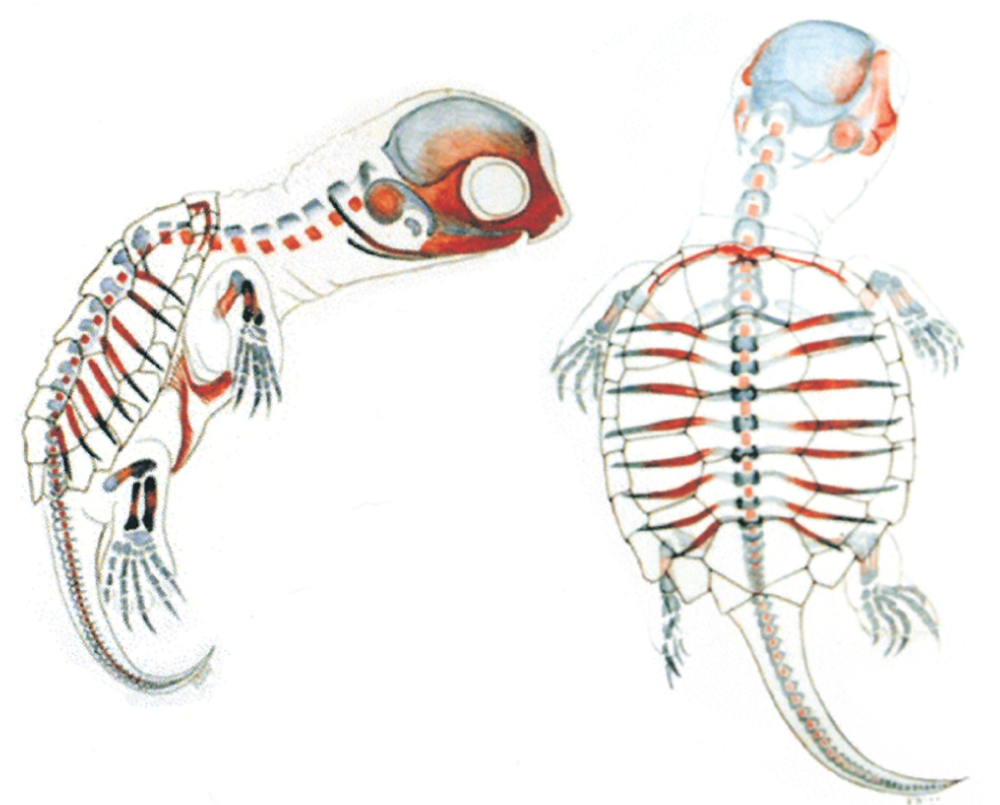
Gilbert SF, Loredo GA, Brukman A, Burke AC (2001) Morphogenesis of the turtle shell: the development of a novel structure in tetrapod evolution.. Evol Dev 3(2):47-58.
Li C, Wu X-C, Rieppel O, Wang L-T, Zhao L-J (2008) An ancestral turtle from the Late Triassic of southwestern China. Nature 456: 497-501.
Nagashima H, Sugahara F, Takechi M, Ericsson R, Kawashima-Ohya Y, Narita Y, Kuratani S (2009) Evolution of the turtle body plan by the folding and creation of new muscle connections. Science 325(5937):193-6.

Thanks for this, PZ.
Now I’m waiting for Chas Petersen to wander by.
Follow the link for Odontochelys to November 2008 and one of the commenters asks about it :
Google ‘Plastron Toboggan’ It goes to the Pandas Thumb where I said:
Since then I realized that a toboggan is a good vehicle for getting over mushy, swampy ground where the surface is too soft for feet to stand on.
I’ve been trying to get my granddaughter to a science fair experiment where bean bag odontochelys are pulled across soft ground, with and without plastrons to see which takes less energy.
Also, in the original post, I know I wrote exaptation. Damn you auto correct.
Nice.
Lies!
Seriously cool stuff, PZ. Thanks.
I gave a talk on the same subject at a Freethought conference last May. It was called ‘The Monkey & Turtle Controversies ‘.
Thanks PZ for the fascinating biology lesson!
In the second-to-last figure (“Evolution of the turtle body plan”), the shoulders of Bob the Basal Amniote are too mammal- or birdlike. They’re mounted too high up and too far back; as you can see, the upper arm threatens to clash with the ribcage every time it moves. The shoulder blades should overlap the ribs much less and look more like in Odontochelys, just not quite as vertical.
This is clear from well-preserved fossils of early amniotes as well as from many extant amniotes. Even in birds, where the shoulder blades proper (the scapulae) are horizontal and overlap many ribs, the coracoids (the long green bars that extend to the midline in the first figure) lie in front of the ribcage.
The second-to-last figure also neglects to mention that Odontochelys did have a carapace. It had the extra plates on top of the vertebrae and the extra plates on top of each rib; it just so happens that the carapace wasn’t very tightly sutured together, so that, in the fossils, the plates on top of the vertebrae are slightly separated from the vertebrae and each rib, with its plate on top, has separated and points in a different direction.
BTW, in the drawings, blue is cartilage and red is bone; this is a common way of staining skeletons.
Of course, it’s not a transitional form the creobots would recognize.
That is fantastic. I’m trying to figure out how I can work it into an animal program about turtles, so that I can expose kids to evolution instead of goddidit as an explanation for the critters we have on display. (Of course, there’s a strong culture in nature education to avoid mentioning the e-word so as not to “offend” the members of the public who come to nature center programs. I tend not to cooperate with this mandate, even when phrased by the administrators as a matter of politeness…)
Mattir, perhaps only work it in at the end? “And that’s called evolution.” *creationists picking up their jaws from the floor*
Well written. relatively clear for a non-biologist.
But it doesn’t fit in with Baraminology at all! /jk
Waiting? Dude, I was already here, this morning.
Lots more cool pictures here.
Technically no, since it’s covered with living skin. In most it’s like the skin over your skull secreted giant fingernails. Sort of.
(There are also softshells without the ‘nails’.)
Now that’s a just-so story.
That is so cool.
Fucking turtles. How do they work?!?
This is seriously awesome. Thanks to PZ’s posts, my interest in biology is up to the level of my interest in physics.
Creatio ex cloaca!
Ah, nuts, real biology.
</snark>Seriously, thanks!
When I asked the original question, I was clearly hoping that either someone would find / know-of a humorous “explanation” — ideally one based exclusively on a model without reference to any evidence — or else invent such on the fly…
For instance, Maxwell’s demon vacations in turtle eggs and can’t resist a practical joke. It sorts ribs to one side and scapula to the other side.
15
And I don’t wanna talk to a scientist
Actually the evodevo course I took was kind enough to cover turtles. Went into detail about the chemical gradients and such for the formation of the carapace ridge (it’s very similar to the chemical cues for limb growth- you might even call it related~) but we lacked that nice transitional form to give quite such a clear explanation of how you could have the bones function in a transitional form.
Win.
Yep. Turtle shell = ectopic limb formation hijacked by the ribs?
There was a great doco “Iside nature’s Giants” which included Richard Dawkins talking about just this turtle evolution issue in part featuring especially the leatherback turtle shown on SBS TV Australia a week or two ago.
See :
http://www.sbs.com.au/documentary/program/606/Inside-Nature-s-Giants
http://www.pbs.org/programs/inside-natures-giants/
&
http://en.wikipedia.org/wiki/Inside_Nature%27s_Giants
Niether of which actually ha sthe episode I saw about afortnight ago. Sigh.
I love these science lessons. Awesome post PZ, thank you.
Yey science!
Hi StevoR,
it looks like SBS TV has been screening them somewhat out of order – I definitely recall seeing episodes from Seasons 1, 4, and 3 (and roughly in that order). The most recent episode was the thoroughbred horse (Season 3 episode 4) and a week earlier was the leatherback sea turtle (Season 3 episode 3).
Dawkins’ small contributions to each of the episodes on the evolutionary biology of the animals under discussion are usually highly illuminating for non-zoologists/biologists such as myself – for example, presenting the evidence that (land) tortoises are a family under the super-family of turtles rather than the sea turtles being an evolutionary adaptation of tortoises (I hope I’ve got that round the right way!); or in the most recent episode, showing various intermediate fossils demonstrating the gradual change to the bone structure of the horse’s hoof, as the hoof is essentially the horny part of a single, massively enlarged finger or toe (like a fingernail or toenail); the intermediate fossils show the gradual enlarging of one of the ‘fingers’ and the dramatic shrinking of the others to their current vestigial appearance (looking at Wikipedia I think they are now the second and fourth metacarpals?).
OH IT’S A FILTHY PROPAGANDA OF SCIENTISM AND MATERIALISM! I DEMAND Answer in Genesis™!
Anyway, I am always starled by sheer obstinacy of creation advocates. They’re babbling about philosophy, complexity, but they never speak clear, never make specific claims.
GREAT READ PZ. WE NEED MORE OF THIS.
Great post but this quote woke up the pedant in me. As you described, dermal bone forms within the dermis of vertebrates (as does the skeleton of many echinoderms.) This makes it endoskeletal, not exoskeletal. AFAIK exoskeletons all are secreted non-living tissue on the outside of the integumentary epithelium, not within or beneath it. I am assuming that you used the terms loosely rather than strictly but it gets me grumpy to see this in an otherwise technically cool post.
Neither.
The last common ancestor of all turtles that survive today was a mostly aquatic animal, similar to a swamp turtle. It lived in the Middle or perhaps earliest Late Jurassic. From this, secondarily terrestrial animals (tortoises*) as well as fully aquatic ones (sea turtles) evolved.
That ancestor, however, is itself descended from a terrestrial animal. The Early Jurassic and the Triassic turtles were all terrestrial, except for the mostly aquatic Odontochelys, and so was their most likely closest relative, Eunotosaurus.
* Not to be confused with what gets called “tortoise” in Australia.
Yep, in the hand; of course the 2nd and 4th metatarsals in the foot.
Then you should have gone the whole way and read comment 12.
Thanks for the post!
Also, Chas, that link to more pictures is great!
You’re making Baby Jesus cry with this biology nonsense. Stop it.
Just kidding. Awesome stuff.
What a creationist will take away from this post:
“So somehow the ribs and scapulae in turtles have flipped their relative positions, which sounds like a radical transformation, and it’s not at all clear how you could do that gradually in evolution.” -PZ Myers
I just want to say thanks PZ. Being an ignorant musician I am a bit lacking in science knowledge but I find things like this fascinating.
You write things simply enough that I can understand what’s going on but not dumbed down to the point where it’s a useless understanding.
Because of posts by you and a couple of other bloggers (like the Bad Astronomer) and vloggers (including Thunderf00t although I’ve now unsubed from him due to his idiocy when it comes to basic human rights) my wife and I are both enrolling in a bridging course at the local uni that covers basics in physics, chem, biology and a bunch of other stuff. I’m sure it’s only basic stuff but I’m only doing it due to the interest that blogs like yours have kindled in me.
So thanks once again: You’re awesome enough to inspire a 29 y.o. to go back to school and learn some science.
“As you described, dermal bone forms within the dermis of vertebrates (as does the skeleton of many echinoderms.) This makes it endoskeletal, not exoskeletal.”
Not in vertebrates. In vertebrates “endoskeletal” refers to bone preformed in cartilage (i.e., endochondral), whereas “exoskeletal” refers to bone formed in the dermis (ie. dermal bone). Note that our skulls are a composite of endo and exo skeletal components.