The Probability Broach, chapter 15
(If you don’t know where the title is from, allow me to introduce you to the Lyttle Lytton Contest.)
Let’s review what The Probability Broach has told us about how its world works.
L. Neil Smith’s North American Confederacy is an anarcho-capitalist society with no police, no laws and no justice system. Furthermore, everyone is armed and ready to kill at a moment’s notice.
According to its author, what makes this society function—as opposed to collapsing into an endless war of all against all—is that there are unwritten rules which everyone respects.
People in the NAC have free speech; no one will blow your head off because they don’t like something you said. If someone attacks you and you shoot them in self-defense, that’s allowable; but if you disarm them, you can’t execute them in cold blood, you have to turn them over to a neutral third party for a trial. Everyone has private property rights; you can’t break into someone’s house and take it over just because you like it better than yours.
Got it? Good. Now let’s look at some passages in the text which show that this is all a dirty lie.
As we saw last week, our heroes know that the villain, John Jay Madison, is plotting to take over the world. But they have no proof. They’re sure that the evidence is in Madison’s house, but there’s no such thing as a search warrant here. So they resolve to do the only thing they can do, which is to illegally break into his house and retrieve it themselves.
Ed and Win Bear are parked outside Madison’s house, engaged in the time-honored ritual of the stakeout:
“Look out!” Ed whispered. We slumped farther down as a pair of enormous black hovercars—the Frontenac, lately repaired, and its twin brother—came around a corner and pulled up in front of the house.
This is the car that fired on Win and almost killed him. The fact that Madison owns it still doesn’t help them, because there’s no law enforcement to which they can report this incriminating fact.
Ed offered me a set of goggles with half-inch slabs for lenses. I started to strap them on, thought better of it, and simply held them before my eyes. “Infrared?” I asked. The images were in color, the hues wildly distorted. The Frontenacs were still black, but the landscaping was sickly shades of red-violet.
“Paratronic. Convert almost anything to visible wavelengths, with pretty strange results sometimes, depending on the—quiet!”
A gang of people have emerged from Madison’s front door. Two of them are Madison and his butler. The other two are people Win recognizes all too well, because they’re from his world.
One is Otis Bealls, former boss of the murdered physicist Vaughn Meiss. The other is Oscar Burgess, the scarred secret-police thug who tried to shut down Win’s investigation.
None of this comes as a surprise to Win, but he wonders just how deep this plot goes:
The gears in my head were grinding. I wasn’t surprised that SecPol had been on my trail, but Burgess himself? Unless they had their own Broach working, he must have followed me to Fort Collins, into the lab, and out through Meiss’s machine. How many others had made it through before the one we’d found got buried in the collapsed excavation?
Fortunately, the villains are leaving. They pile into their car and drive off. Once they’re gone, Ed and Win circle around to the back side of Madison’s mansion.
They crouch by the door, and Ed pulls out an unfamiliar device. Pay close attention to this part:
Ed produced a device, slid out an antenna, and unfolded a sharp-pointed ground stake.
“This is my defeater—like the one our burglar used.”
“I hope it works better than his did.”
As you may remember, in an earlier chapter, Win was almost murdered by an assassin who broke into Ed’s home. The hitman got in with the help of a defeater, a piece of tech that disables someone else’s burglar alarms.
As I pointed out at the time, there’s no non-criminal use for such a device. The fact that you can go out and buy one—apparently there are businesses that manufacture them—has unsavory implications for the NAC. Why would that business even exist, if everyone here is so unfailingly respectful of everyone else’s private property?
And now we find out that Ed Bear, one of the heroes, owns one too!
Ed explains that his defeater works on a different principle: it connects to his computer at home, and if they trip any sensors, his computer will “start arguing” with Madison’s computer and delay the alarm from going off. Once that happens, they’ll have a few extra minutes to make their getaway.
My hands shook as I accepted another gadget. “S-sorry. I’m used to working the other side of the burglary game!”
“Calm down! You don’t hear my teeth chattering, and I’m not used to it, either.”
This is an outright lie. It has to be. If Ed isn’t used to burglarizing other people’s houses, why would he own a device whose only purpose is to help him do that?
But wait, you say. Maybe Ed is an honest man who never usually stoops so low. Maybe he bought the defeater just for this job.
Nope—because as the next paragraph shows, he owns other burglary tools too, and he has experience with them:
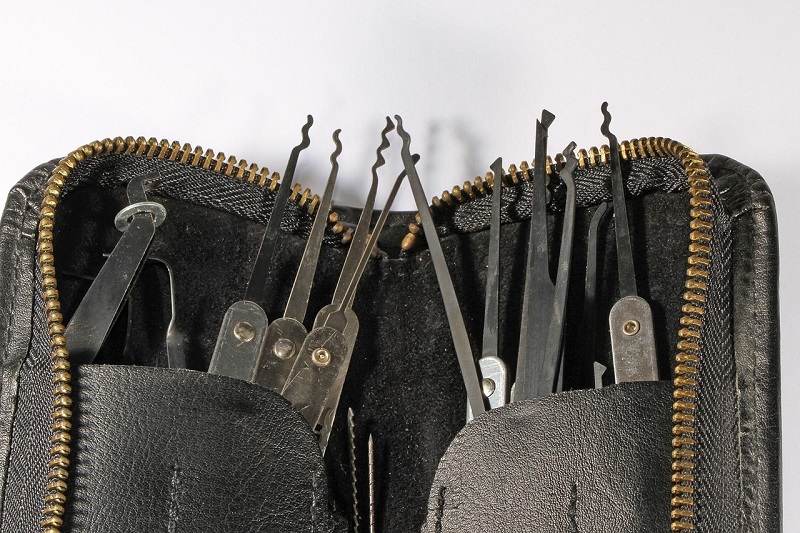
The back porch wasn’t locked, but the floorboards were real groaners. By the time Ed was doing things to the back door with tiny tools, I was surprised my pants were still dry. He taped the latch to keep it from springing shut.
Lockpicking isn’t something you just pick up! It takes lots and lots of practice to be good at it. (People like Lockpicking Lawyer just make it look easy.) There’s no way Ed would be able to do this on his first try. He’s clearly done it before.
Based on this chapter, all the NAC’s rhetoric about the sanctity of private property rights is so much lip service. They all say it, but no one believes it. Everyone in this world owns crime stuff and has practice in using it.
This tracks with other evidence from the text. It’s supposed to be illegal to torture or threaten a captive, but Win did just that, and his friends all overlooked it. They were a little upset, but they didn’t cast him out or shun him, the way people in the NAC are supposed to do to wrongdoers.
The conclusion to draw from this, even if the author didn’t intend it, is that these unwritten “rights” are worthless. People in the NAC hypocritically claim to respect them, but flagrantly violate them whenever it serves their interests. I’d argue that that’s unintentionally realistic, and exactly what we should expect in a society like this.
New reviews of The Probability Broach will go up every Friday on my Patreon page. Sign up to see new posts early and other bonus stuff!
Other posts in this series: