

Mohave ground squirrels at a camera trap bait pile. Not shown: “Free Skwirl Fud” sign. Photo by U.S. Army Engineer Research & Development Center
It’s a year old, but I just read a paper on one of those species that pops up pretty frequently in environmental impact reports — the Mohave ground squirrel, Xerospermophilus mohavensis — whose conclusions add a little bit more depth to the Deep Time perspective of the desert around here. And by “depth” I mean “epic stories.”
And by “around here,” I mean “at least 45 miles northwest of here”: the Mohave ground squirrel’s range is all on the other side of the Mojave River, aside from a strip of land a few miles wide along the north desert foothills of the San Bernardino Mountains, where it mostly hasn’t been seen for the last few decades anyway. The squirrels’ historic range was somewhere in the neighborhood of 7,000 square miles or 20,000 km2, depending on which authority’s rounded-off guesstimate you use.
The Mohave ground squirrel is a foliage and seed eater — you may have guessed that second part from “Xerospermophilus,” which essentially means “desert seed lover.” It’s about nine inches nose to tail, short-haired, roughly ground-squirrel-shaped, ranges in color from pinkish to gray to cinnamon, in a more or less solid-colored coat. The species is rare throughout its range, which is shown in the U.S. Fish and Wildlife Service map embedded below:
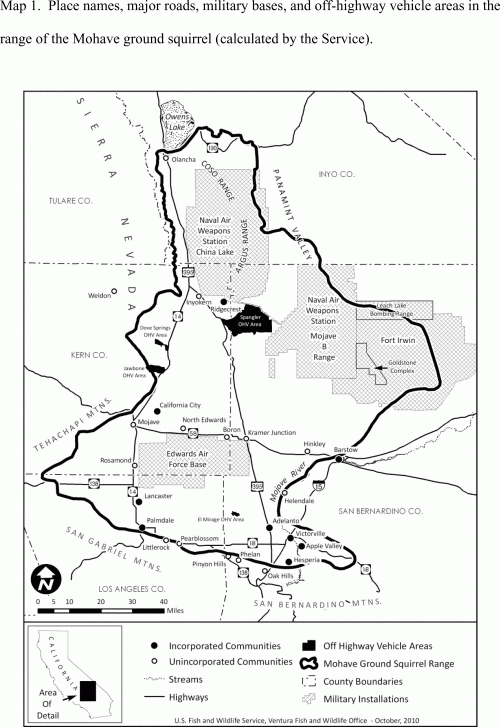
That map is from the Federal Register, dated October 2011, in a “Finding” that the squirrel didn’t warrant protection as endangered or threatened under the U.S. Endangered Species Act. That finding was more politics than science. The squirrel is threatened by urban and industrial development, off-road vehicle use, and by climate change. Under CalESA, the California version of that law, the squirrel is listed as “Threatened”: the IUCN classifies the species as “vulnerable.”
The authors of the paper I mentioned up top, K.C. Bell and Marjorie Matocq, wanted to learn more about historic habitat colonization and connectivity among Mohave ground squirrel populations. They sampled nuclear and mitochondrial DNA from 258 individual squirrels collected in 13 locations throughout the species’ range, then charted the genetic diversity among the samples. They also sampled nearby populations of the closely related round-tailed ground squirrel, Xerospermophilus tereticaudus, and some suspected hybrids between the two species.
Bell and Matocq found that the Mohave ground squirrel species comprised three genetically distinct geographical populations — one from the northern part of the species’ range, one occupying the west-central part, and one in the range’s southern extension. The populations aren’t reproductively isolated: there’s unambiguous evidence of gene flow among all three groups, though the northern population seems more isolated from the other two. The southern population turned out to be more genetically diverse than the other two, which supported earlier researchers’ suggestions that the squirrels have inhabited the southern part of their range for significantly longer, evolving genetic diversity. Populations to the north would have been established by small “founder” groups, and would thus have less diversity.
When you talk about the Mojave Desert more than 11,000 years ago, you’re talking about a very different place than the Mojave Desert of today. For one thing, there were elephants and lions and saber-toothed cats and sloths the size of cows wandering around there. For another thing, there were huge lakes for them to wander past. 11,000 years ago the Mojave Desert was enjoying a pluvial period, with warm, wet weather, and all across the desert valleys were filled with lakes.
In the northern Mojave, the Owens River — now a pale shadow of even its 19th Century self — filled a chain of five gigantic lakes with runoff from the glaciated Sierra Nevada. At the end of the line was Lake Manly, 80 miles and 600 feet deep at its largest, filling Death Valley. Lake Manly was fed by overflow from Panamint Lake, in the next valley to the west. Panamint Lake was fed by overflow from Searles Lake, now the site of the trona mine at Trona, California. Searles Lake was fed by China Lake, now the site of a U.S. Naval Air Station. China Lake was fed by Owens Lake, up at the top of the chain.
Twelve thousand years ago the climate started getting drier. Sierra Nevada runoff didn’t run off the Sierra Nevada quite as abundantly. Lake levels dropped across the desert, and eventually — when the level of China Lake dropped below its spillover into Searles Lake — Searles Lake dried up.
Which was about the time Mohave ground squirrels started moving north, across land that had once been flooded, to the territory on what had been the far shore. After 7,000 years another wet cycle — about 3,500 years ago — filled Searles Lake again, isolating squirrels in the northern population from their cousins to the south. The lake lasted long enough that the northern and southern populations of ground squirrels evolved every so slightly away from each other.
And then the lake dried up again, and squirrels moved into the land where it had been, forming the central-western population.
If the lake had lasted for longer, two species of Mohave ground squirrel could have been the result. That’s almost exactly how the Mohave ground squirrel species itself came into being, split off from its sister species, the round-tailed ground squirrel, X. tereticaudus. I mentioned above that the Mojave River marks a major boundary of the Mohave ground squirrel’s range. There are ground squirrels on the other side of the river too: round-taileds. The river itself isn’t much of a barrier: for most of its 110-mile length, most of the time, it flows underground. There’s not enough of a barrier there to split a species: a squirrel could cross it 364.9 days out of 365 without getting its feet damp.
Up until 6,000 years ago, though, there was usually a lot more water in the Mojave. Fed by runoff from the Transverse Ranges in Southern California, it made its own chain of lakes across the southern Mojave Desert, which chain may also have ended in Lake Manly — at least in phenomenally wet years. But there were dry periods even then, and at one point during one of those prolonged droughts the ancestors of Mohave and round-tailed ground squirrels ranged across it all.
Somewhere around 1.6 million years ago the Mojave River filled back up again. The ancestors of Mohave ground squirrels stood on the northwest bank, looking across at the ancestors of round-tailed ground squirrels on the far shore. Eventually they evolved in different directions. The river dried up 6,000 years ago, and there’s been some movement of each species across the river since, with some evidence of interbreeding — though Bell and Matocq found that two of three putative hybrid squirrels kept in storage since the 1980s-90s were actually pure round-tails, with no Mohave ancestry — that interbreeding is rare enough to be insignificant. The two species have diverged.
So, reproductive isolation can cause genetic divergence and even speciation. Nothing new there. But I’ve long thought of the Great Divide between Mohave and round-tailed ground squirrels as one of the wonderful epic tales of Evolution: There was once a nation that was divided by a flood, and when they eventually reunited they had become irrevocably different. When I learned that story what had been a mere edge of a line on a range map became, in my mind, a saga millions of years in the unfolding. And there are stories like that everywhere you look in the natural world. Sometimes they’re obvious, an abrupt discontinuity between two related species. And sometimes, as with Bell and Matocq’s work, you need to dig stories out of mitochondria and read them in scatter plots.
But they’re there, and as old and jaded as I am I often wish I had a few more centuries left me in which to hear them all.
Bell, K. C. and Matocq, M. D. (2011), Regional genetic subdivision in the Mohave ground squirrel: evidence of historic isolation and ongoing connectivity in a Mojave Desert endemic. Animal Conservation, 14: 371–381. doi: 10.1111/j.1469-1795.2011.00435.x

Epic, indeed. Thank you for this.
Growing up (eastern Ontario), squirrels were a pest that liked to nest in the insulation. Where I am now (northeastern Europe), squirrels are a rarity. It’s always nice to learn about other squirrels out there, the ones who somehow survive without trees… :)
To me ground squirrel will always sound like a condiment.
Unfortunately, Urk’s Tribal Council decreed in the 57th year of the Shiny Rock that the giant sloths didn’t warrant protection (Urk infamously ruled that they were “threatened, all right… threatened by Urk’s spear!”)
I guess the Sloth Milk Lobby wasn’t strong enough to stand against that, no matter their good intentions…
But they’re still squirrel-kind, so it’s not macroevolution. #sarcasm
@rq
Just how high up north are you? I’m also in northeastern Europe and squirrels are a menace.
Meanwhile, on the other side of the continent….
@pj
A menace? How can they be a menace?!
Btw, I did some undergraduate research on the eastern grey squirrel. Awesome in North America, not so awesome in the UK.
Not so awesome in the Western US either, where it’s an introduced pest. The native squirrels, half its size, can’t really compete.
Hopefully this will be a link to a native making a visit to my bird feeder:
http://cosmoquest.org/forum/showthread.php/97366-Backyard-Wildlife?p=2065630#post2065630
Old home week. I used to live in the black dot right in the center of that map. Never paid much attention to the squirrels. Thanks for this post.
Wow, fascinating history about something I wouldn’t have given a second thought. Thanks for sharing the story.
This makes only about the zillionth time I wish I had a time machine. I’d love to see the Mojave as it looked in the past.
Strange you should ask, I just got this email from Mrs. BDC
great.
There goes Saturday. I cannot wait for meet all the nice Black Widows in there.
Oh, wow, ground squirrels.
We used to have a few of those out at Christina Lake, in the Kootenay Boundary of southeastern British Columbia. Utterly fearless things. My grandfather would feed one unpopped popcorn out of his hand, and when it had finished the amount in his hand, it would sometimes run up his arm to get the rest of the popcorn in his shirt pocket.
Then an owl came through the area, and the next year there weren’t any ground squirrels, just their smaller and more skittish chipmunk cousins. (Well, technically chipmunks are a subtribe of ground squirrels, I suppose, but we still had one type killed off and replaced by another.)
When evolution is looked at or at least described in the abstract or general way it seems hard to understand, like how could that just happen. This little story about a particular animal makes it simple to understand and amazing to realizing that it is continuing right along one generation one individual at a time doing simple things eating, sleeping and “makin babies”. It is made clear that there are not any real fixed points nothing is unchanging except maybe change.
I like squirrels but I have very mixed feelings about many “wild animals” when they are around my property while they are beautiful they are also destructive to things I chose to value like roofs, buildings in general, fruits and vegetables they even like to change the grading of the dirt.
great post
Very interesting story. I just applied for a biodiversity informatics position and if I somehow happen to get it I imagine I should be seeking out more studies like this.
@pj #6:
Latvia. Officially classified as eastern Europe, but I prefer to think of it as ‘north’. Where are you, if squirrels are a menace?? Are they after your winter store of nuts?
And yes, squirrels can be a menace. Horrible little things (the infesting variety – the little red ones were ok, but the black/grey ones were just nasty rabid rodents that the dog loved to scare into the trees).
Conversely, there’s the story of the snapping shrimp that speciated following the emergence of the Panamanian isthmus. Nancy Knowlton at the Smithsonian Tropical Research Institute has done a lot of interesting research on that system.
Travis @15 – the position in Brazil, by chance? I applied for that one too. I’d say “small world”, but it makes sense that academic biodiversity types would congregate here
The squirrel native to my forest is gone; they were apparently twice the size of the grey squirrels but had a slower metabolism and larger babies. Alas.