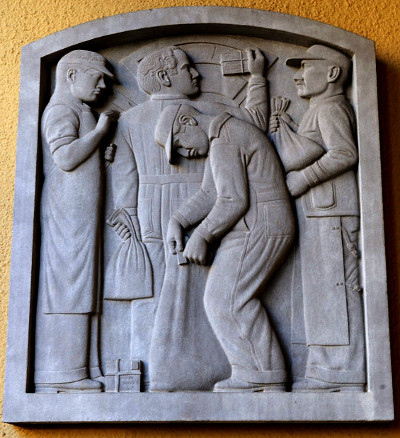
How can it be with things like this in it?
You can keep your jetpacks if I can have more like this.
May 13 2013
How can it be with things like this in it?
You can keep your jetpacks if I can have more like this.
May 12 2013
By now, you may have seen Ophelia or PZ talking about Justicar’s latest “You’re not really sincere because of this stupid thing I just made up and am treating as gospel truth” video. This one claimed that none of us feminist bloggers is really threatened by anything because we haven’t gone into hiding and obliterated all traces of where we live. The proof? Jen tweeted a picture of something near her apartment with an identifiable street sign…or something equally stupid.
Yes, you see, Jen having suffered a depressive episode and basically given up on blogging and on the secular and skeptical movements isn’t enough to demonstrate a negative effect. If her life isn’t destroyed to the point that she’s afraid to tweet something silly she sees on the street, the harassment she continues to receive–months after she’s stopped her activism–isn’t really harassment and no one should complain about it.
I will, for the sake of its utter obviousness, not bother to detail the glaring fallacy. I won’t linger of what a slimy excuse for a human being Justicar is. Instead, I’m going to tell you a little story about my Friday night.
May 11 2013
I’ve posted short stories by James Schmitz before, but he’s one of my favorite SF authors. Also, this week reminded me why he’s one of my favorite SF authors. I think this story illustrates it well.
At that moment, up at the farmhouse, a cow horn went “Whoop-whoop!” across the valley.
“Darn,” said Grimp. “I knew it was getting late, with him doing all that talking! Now they’re calling me to supper.” There were tears of disappointment in his eyes.
“Don’t let it fuss you, Grimp,” Grandma said consolingly. “Just jump up in here a moment and close your eyes.”
Grimp jumped up into the trailer and closed his eyes expectantly.
“Put out your hands,” Grandma’s voice told him.
He put out his hands, and she pushed them together to form a cup.
Then something small and light and furry dropped into them, caught hold of one of Grimp’s thumbs, with tiny, cool fingers, and chittered.
Grimp’s eyes popped open.
“It’s a lortel!” he whispered, overwhelmed.
“It’s for you!” Grandma beamed.
Grimp couldn’t speak. The lortel looked at him from a tiny, black, human face with large blue eyes set in it, wrapped a long, furry tail twice around his wrist, clung to his thumb with its fingers, and grinned and squeaked.
“It’s wonderful!” gasped Grimp. “Can you really teach them to talk?”
“Hello,” said the lortel.
“That’s all it can say so far,” Grandma said. “But if you’re patient with it, it’ll learn more.”
“I’ll be patient,” Grimp promised, dazed. “I saw one at the circus this winter, down the valley at Laggand. They said it could talk, but it never said anything while I was there.”
“Hello!” said the lortel.
“Hello!” gulped Grimp.
The cow horn whoop-whooped again.
“I guess you’d better run along to supper, or they might get mad,” said Grandma.
“I know,” said Grimp. “What does it eat?”
“Bugs and flowers and honey and fruit and eggs, when it’s wild. But you just feed it whatever you eat yourself.”
“Well, good-by,” said Grimp. “And golly—thanks, Grandma.”
He jumped out of the trailer. The lortel climbed out of his hand, ran up his arm, and sat on his shoulder, wrapping its tail around his neck.
“It knows you already,” Grandma said. “It won’t run away.”
Grimp reached up carefully with his other hand and patted the lortel.
“I’ll be back early tomorrow,” he said. “No school . . . They won’t let me out after supper as long as those lights keep coming around.”
The cow horn whooped for the third time, very loudly. This time it meant business.
“Well, good-by,” Grimp repeated hastily. He ran off, the lortel hanging on to his shirt collar and squeaking.
Grandma looked after him and then at the sun, which had just touched the tops of the hills with its lower rim.
“Might as well have some supper myself,” she remarked, apparently to no one in particular. “But after that I’ll have to run out the go-buggy and create a diversion.”
Lying on its armor-plated belly down in the meadow, the pony swung its big head around toward her. Its small yellow eyes blinked questioningly.
“What makes you think a diversion will be required?” its voice asked into her ear. The ability to produce such ventriloquial effects was one of the talents that made the pony well worth its considerable keep to Grandma.
“Weren’t you listening?” she scolded. “That policeman told me the Guardian’s planning to march the village’s defense unit up to the hollow after supper, and start them shooting at the Halpa detector-globes as soon as they show up.”
The pony swore an oath meaningless to anyone who hadn’t been raised on the planet Treebel. It stood up, braced itself, and began pulling its feet out of the mud in a succession of loud, sucking noises.
“I haven’t had an hour’s straight rest since you talked me into tramping around with you eight years ago!” it complained.
“But you’ve certainly been seeing life, like I promised,” Grandma smiled.
The pony slopped in a last, enormous tongueful of wet weeds. “That I have!” it said, with emphasis.
It came chewing up to the road.
“I’ll keep a watch on things while you’re having your supper,” it told her.
May 10 2013
John Shook has a post up over at CFI about scientific skepticism versus rationalist skepticism with regard to religious claims. He notes that calls for scientific skepticism are not universal among skeptics, and he gives a fascinating bit of history on who originated the call for scientific skepticism to be applied to religion. Read the whole thing.
The first comment, however, raises a misconception that I’d like to address:
Whenever I hear someone talk about what other people should/should not accept/believe as if they know the absolute truth, I wonder how they differ from all of the other people who think that they, too, know the absolute truth.
Here’s the thing: That’s not what we do. It’s a common misconception based, I think, in the fact that we tend to get more attention when we’re talking about politics than when we’re talking about belief and epistemology (and the fact that you can now find atheist skeptics talking among themselves), but it isn’t true. There is no knowledge of absolute truth required to talk about what people should or shouldn’t accept as the skeptical position on religion.
May 10 2013
Ryan McIlvain is a former Mormon missionary whose missionary work presented challenges to his faith that ultimately led him away from Mormonism. He is also a recent first-time novelist who took “Write what you know” to heart, capturing that experience in the recently released Elders: A Novel. From the publisher’s description:
Elder McLeod—outspoken, surly, a brash American—is nearing the end of his mission in Brazil. For nearly two years he has spent his days studying the Bible and the Book of Mormon, knocking on doors, teaching missionary lessons—“experimenting on the word.” His new partner is Elder Passos, a devout, ambitious Brazilian who found salvation and solace in the church after his mother’s early death. The two men are at first suspicious of each other, and their work together is frustrating, fruitless. That changes when a beautiful woman and her husband offer the missionaries a chance to be heard, to put all of their practice to good use, to test the mettle of their faith. But before they can bring the couple to baptism, they must confront their own long-held beliefs and doubts, and the simmering tensions at the heart of their friendship.
McIlvain joins us this Sunday to talk about the novel and about his experiences.
Related Links:
Listen to AM 950 KTNF this Sunday at 9 a.m. Central to hear Atheists Talk, produced by Minnesota Atheists. Stream live online. Call in to the studio at 952-946-6205, or send an e-mail to [email protected] during the live show. If you miss the live show, listen to the podcast later.
Follow Atheists Talk on Facebook and Twitter for regular updates. If you like the show, consider supporting us with a one-time or sustaining donation.
May 08 2013
Daniel Loxton has a post up at Skepticblog today titled “‘Testable Claims’ is Not a ‘Religious Exemption’“. Although the article doesn’t specify or provide any links, it is, in large part, a response to PZ’s recent “divorce” from the organized skeptical movement and the arguments leading up to it. From Loxton’s article:
What are we to make of accusations that skepticism’s “testable claims” scope is a cynical political dodge, a way to present skeptics as brave investigators while conveniently arranging to leave religious feathers unruffled? Like the other clichés of my field (“skeptics are in the pocket of Big Pharma!”) this complaint is probably immortal. No matter how often this claim is debunked, it will never go away.
Nonetheless, it is grade-A horseshit. It’s become a kind of urban legend among a subset of the atheist community—a misleading myth in which a matter of principle is falsely presented as a disingenuous ploy. There is (and this cannot be emphasized enough) no “religious exemption” in skepticism. Skeptics do and always have busted religious claims.
Loxton sounds a bit frustrated, and well he may. He’s said this sort of thing plenty of times before, but it hasn’t settled the claims. Of course, there’s a reason for that. Loxton is completely missing the point.
May 07 2013
A couple of weekends ago, I was at Omegacon for a bit of enforced relaxation. Yes, it really is an F&SF convention that people attend in their pajamas.
While we were there, a couple of my network mates and I got together with our friends from the Geeks Without God podcast to play Left Behind: The Movie, The Board Game Adventure. (I swear to you on all that is unholy that this is really the name of the game.) Being who we are, we also set up a microphone to capture the event.
I can’t tell you how much we were looking forward to this. It played no small part in the decision to leave my bedroom after an insane week that involved a business trip and traveling to the emergency room before dawn in a city I’d never been to before. Yes, everyone will be fine, but I was a bit of a wreck. But this! The Left Behind board game! The lulz!
How can you not play this game when offered the opportunity?!
Well, frankly, you can just listen to the podcast. We weren’t expecting anything good, but this game was bad in the very worst way that a game can be bad. All I can say is hooray for making up your own rules. And for moonshine-soaked cherries. Those helped even those of us who don’t like booze.
So go listen. Play the podcast drinking game if you feel so inclined. If you still feel you must play this when you’re done, leave a comment at Geeks Without God. I don’t know whether they’ve found a new home for the game, but I know no one there wanted to keep it, even as a novelty.
May 06 2013
All right. For realz this time, we’re moving back to Wednesdays. This Wednesday, May 8, we’re exploring hacksploitation cinema. That’s a thing, right? Because something like .com for Murder is better–or at least fundable–if you put it in virtual reality. You can tell it must be great, because we can’t find a trailer. Have a terrible movie poster instead.
This one is available on Netflix. Do help us mock it, won’t you?
May 05 2013
I was just talking with an avid baker about the problems of baking for people with celiac disease. (Minnesota has a large Nordic population, which gives a higher-than-average concentration of the disorder.) I mentioned that I developed a flour mix that I like and have had good enough results with that I don’t bother with xantham gum or other additives as long as I’m not trying to make yeast breads (which I leave to professionals).
This is an easy mix in the proportions, though it does take a little bit of extra processing. It’s also based on my thinking about what flour does in various recipes, so others may find it useful in trying to create their own flour mixes for various purposes, like cakes. Personally, I’d get rid of the rice flour for cakes and use only the other three, or even just a mix of tapioca and corn/potato flours.
Gluten-Free Flour Mix
1 lb. rice flour/starch, run through a food processor1 lb. sorghum or oat flour
1 lb. corn or potato starch
1 lb. tapioca flour
Mix thoroughly in a large bowl. I use a whisk but stir slowly so as not to get flour all over my kitchen.
Most importantly, none of these flours taste remotely like beans.
Enjoy.
May 04 2013
It isn’t news that some believers are so ready for the end times that they’re ready to help bring it about. It is news, however, and slightly terrifying, just how many of these believers there are.
“[T]he fact that such an overwhelming percentage of Republican citizens profess a belief in the Second Coming (76 percent in 2006, according to our sample) suggests that governmental attempts to curb greenhouse emissions would encounter stiff resistance even if every Democrat in the country wanted to curb them,” Barker and Bearce wrote in their study, which will be published in the June issue of Political Science Quarterly.
The study, based on data from the 2007 Cooperative Congressional Election Study, uncovered that belief in the “Second Coming” of Jesus reduced the probability of strongly supporting government action on climate change by 12 percent when controlling for a number of demographic and cultural factors. When the effects of party affiliation, political ideology, and media distrust were removed from the analysis, the belief in the “Second Coming” increased this effect by almost 20 percent.
Just in case you wondered why some of us are interested in loosening belief and encouraging uncertainty, well, our futures may depend on it.
Recent Comments